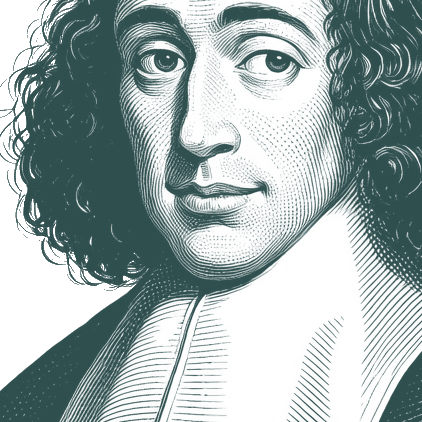
Benedictus de Spinoza (24 November 1632 – 21 February 1677) was a social and metaphysical philosopher known for the elaborate development of his monist philosophy, which has become known as Spinozism. Controversy regarding his ideas led to his excommunication from the Jewish community of his native Amsterdam. He was named Baruch ("blessed" in Hebrew) Spinoza by his synagogue elders and known as Bento de Spinoza or Bento d'Espiñoza, but afterwards used the name Benedictus ("blessed" in Latin) de Spinoza.
Native Name:
בָּרוּךְ שְׂפִּינוֹזָה
•
Benedito de Espinosa
Alternative Names:
Benedict de Spinoza
•
Baruch de Espinosa
•
Barukh Shpinozah
•
Benoît de Spinoza
•
Sbīnūzā
•
Ispīnūzā
•
Barukh Spinoza
•
Bento de Espinosa
•
Baruch d' Espinoza
•
Shpinozah
•
Baruch de Spinoza
•
Spinoza
•
Benoit de Spinoza
•
Benedictus De Spinoza
•
Benedictus Spinoza
•
Baruch Spinoza
•
Baruch Benedictus de Spinoza
...Subsequently, he [Romain Rolland] discovered a third master, a liberator of his faith. This was Spinoza, whose acquaintance he made during an evening spent alone at school, and whose gentle intellectual light was henceforward to illumine Rolland's soul throughout life. The greatest of mankind have ever been his examples and companions.
Pride is pleasure arising from a man's thinking too highly of himself.
PREMIUM FEATURE
Advanced Search Filters
Filter search results by source, date, and more with our premium search tools.
Spinoza's "theory" rejected every illusion about ideology, and especially about the number one ideology of that time, religion, by identifying it as imaginary. But at the same time it refused to treat ideology as a simple error, or as naked ignorance, because it based the system of this imaginary phenomenon on the relation of men to the world "expressed" by the state of their bodies. This materialism of the imaginary opened the way to a surprising conception of the First Level of Knowledge: not at all, in fact, as a "piece of knowledge", but as the material world of men as they live it, that of their concrete and historical existence. Is this a false interpretation? In certain respects, perhaps, but it is possible to read Spinoza in such a way. In fact his categories do function, daringly, in this way in the history of the Jewish people, of its prophets, of its religion, and of its politics, where the primacy of politics over religion stands out clearly, in the first work which, after Machiavelli, offered a theory of history. But this theory of the imaginary went still further. By its radical criticism of the central category of imaginary illusion, the Subject, it reached into the very heart of bourgeois philosophy, which since the fourteenth century had been built on the foundation of the legal ideology of the Subject. Spinoza's resolute anti-Cartesianism consciously directs itself to this point, and the famous "critical" tradition made no mistake here. On this point too Spinoza anticipated Hegel, but he went further. For Hegel, who criticized all theses of subjectivity, nevertheless found a place for the Subject, not only in the form of the "becoming-Subject of Substance" (by which he "reproaches" Spinoza for "wrongly" taking things no further than Substance), but in the interiority of the Telos of the process without a subject, which by virtue of the negation of the negation, realizes the designs and destiny of the Idea. Thus Spinoza showed us the secret alliance between Subject and Goal which "mystifies" the Hegelian dialectic.