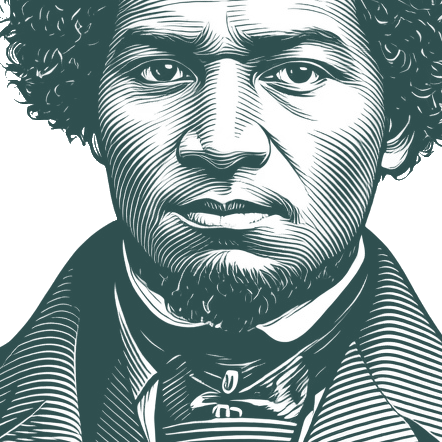
Two hundred years ago there were two distinct and separate streams of human life running through this country. They stood at opposite extremes of eth… - Frederick Douglass
""
Two hundred years ago there were two distinct and separate streams of human life running through this country. They stood at opposite extremes of ethnological classification: all black on the one side, all white on the other. Now, between these two extremes, an intermediate race has arisen, which is neither white nor black, neither Caucasian nor Ethiopian, and this intermediate race is constantly increasing. I know it is said that marital alliance between these races is unnatural, abhorrent and impossible; but exclamations of this kind only shake the air. They prove nothing against a stubborn fact like that which confronts us daily and which is open to the observation of all. If this blending of the two races were impossible we should not have at least one-fourth of our colored population composed of persons of mixed blood, ranging all the way from a dark-brown color to the point where there is no visible admixture. Besides, it is obvious to common sense that there is no need of the passage of laws, or the adoption of other devices, to prevent what is in itself impossible.
Frederick Douglass (c. February 1818 – 20 February 1895) was an American abolitionist, orator, author, editor, reformer, women's rights advocate, and statesman during the American Civil War. He was born a slave in Maryland, as Frederick Augustus Washington Bailey.
Biography information from
Wikiquote·
Portrait adapted from
Wikimedia Commons, Engraved by J.C. Buttre from a daguerreotype. (Public domain / CC0)
Also Known As
Birth Name:
Frederick Augustus Washington Bailey
Alternative Names:
Frederick Augustus Washington Baly
•
Fred Bailey
•
Freddie Bailey
The truth is, the people here know nothing of the republican Negro hate prevalent in our glorious land. They measure and esteem men according to their moral and intellectual worth, and not according to the color of their skin. Whatever may be said of the aristocracies here, there is none based on the color of a man's skin.
A man’s troubles are always half disposed of when he finds endurance the only alternative.
Enhance Your Quote Experience
Enjoy ad-free browsing, unlimited collections, and advanced search features with Premium.
Tarry here for a moment. My words shall be few and simple. The solemn rites of this hour and place call for no lengthened speech. There is, in the very air of this resting-ground of the unknown dead a silent, subtle and all-pervading eloquence, far more touching, impressive, and thrilling than living lips have ever uttered. Into the measureless depths of every loyal soul it is now whispering lessons of all that is precious, priceless, holiest, and most enduring in human existence.