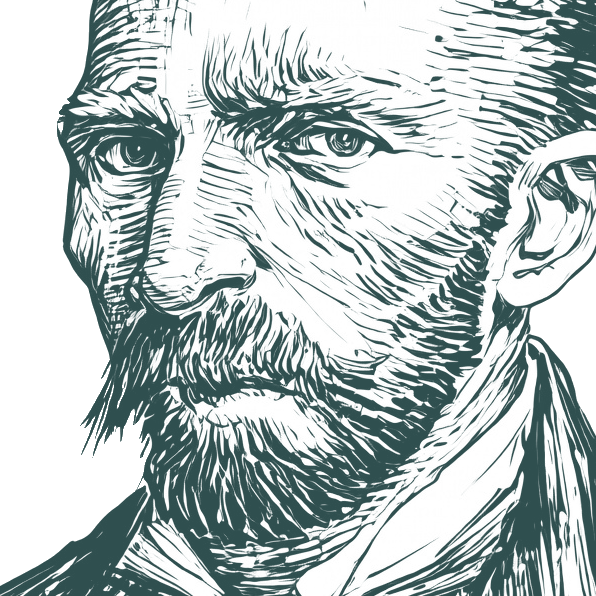
Așa stau lucrurile, dar oare ce se petrece înlăuntrul nostru se vede și din afară? Un om poartă în suflet un foc imens și nimeni nu vine niciodată să… - Vincent van Gogh
""
Așa stau lucrurile, dar oare ce se petrece înlăuntrul nostru se vede și din afară? Un om poartă în suflet un foc imens și nimeni nu vine niciodată să se încălzească la el, iar trecătorii nu deslușesc decât un firicel de fum, sus la gura hornului, și-și caută mai departe de drum.
Romanian
Collect this quote
About
Vincent van Gogh
Vincent Willem van Gogh (30 March 1853 – 29 July 1890) was a Dutch Post-Impressionist painter who posthumously became one of the most famous and influential figures in Western art history. In a decade, he created about 2,100 artworks, including around 860 oil paintings, most of which date from the last two years of his life. They include landscapes, still lifes, portraits, and self-portraits, and are characterised by bold colours and dramatic, impulsive and expressive brushwork that contributed to the foundations of modern art. Not commercially successful, he struggled with severe depression and poverty, eventually leading to his suicide at age thirty-seven.
Biography information from
Wikiquote·
Portrait adapted from
Wikimedia Commons, Vincent van Gogh (CC BY-SA)
Also Known As
Alternative Names:
Vincent Willem van Gogh
•
van Gogh
•
Vincent Van Gogh
•
Van Gogh
Do you know what I long for sometimes? To make a trip to Brabant. I should love to draw the old churchyard at Nuenen, and the weavers. To make, for instance, during a month, studies of Brabant, and to come back [to The Hague] with a lot of them, for a large drawing of a peasant funeral for instance.
Like me, for instance, who can count so many years in my life when I completely lost all inclination to laugh, leaving aside whether or not this was my own fault, I for one need above all just to have a good laugh. I found that in Guy de Maupassant and there are others here, Rabelais among the old writers, Henri Rochefort among today's, where one can find that — Voltaire in 'Candide'. On the contrary, if one wants truth, life as it is, De Goncourt, for example, in 'Germinie Lacerteux', 'La fille Elisa', Zola in 'La joie de vivre' and 'L'assommoir' and so many other masterpieces paint life as we feel it ourselves and thus satisfy that need which we have, that people tell us the truth. The work of the French naturalists Zola, Flaubert, Guy de Maupassant, De Goncourt, Richepin, Daudet, Huysmans is magnificent and one can scarcely be said to belong to one's time if one isn't familiar with them.
PREMIUM FEATURE
Advanced Search Filters
Filter search results by source, date, and more with our premium search tools.
Now I ask you whether you yourself have not often noticed that the policy of floating between the old and the new is not tenable? Just think this over. Sooner or later it ends with one's standing frankly either to the right or to the left. It is no ditch, and I repeat, then it was '48 [the 1848 Revolutions in Europe,] now it is '84 ; then there was a barricade of paving stones - now it is not of stones, but a barricade as to the incompatibility of old and new.