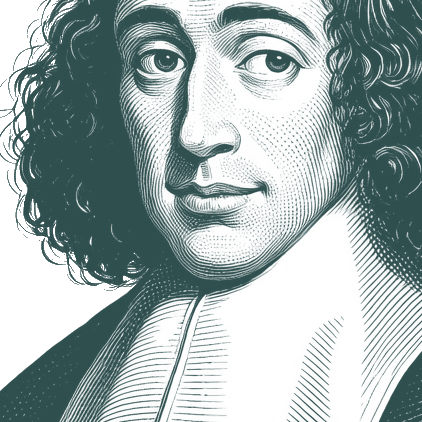
...To the extent that we are committed to the ideal of a secular society free of ecclesiastic influence and governed by toleration, liberty, and a co… - Benedictus de Spinoza
""
...To the extent that we are committed to the ideal of a secular society free of ecclesiastic influence and governed by toleration, liberty, and a conception of civic virtue; and insofar as we think of true religious piety as consisting in treating other human beings with dignity and respect, and regard the Bible simply as a profound work of human literature with a universal moral message, we are the heirs of Spinoza's scandalous treatise [Tractatus Theologico-Politicus].
Benedictus de Spinoza (24 November 1632 – 21 February 1677) was a social and metaphysical philosopher known for the elaborate development of his monist philosophy, which has become known as Spinozism. Controversy regarding his ideas led to his excommunication from the Jewish community of his native Amsterdam. He was named Baruch ("blessed" in Hebrew) Spinoza by his synagogue elders and known as Bento de Spinoza or Bento d'Espiñoza, but afterwards used the name Benedictus ("blessed" in Latin) de Spinoza.
Native Name:
בָּרוּךְ שְׂפִּינוֹזָה
•
Benedito de Espinosa
Alternative Names:
Benedict de Spinoza
•
Baruch de Espinosa
•
Barukh Shpinozah
•
Benoît de Spinoza
•
Sbīnūzā
•
Ispīnūzā
•
Barukh Spinoza
•
Bento de Espinosa
•
Baruch d' Espinoza
•
Shpinozah
•
Baruch de Spinoza
•
Spinoza
•
Benoit de Spinoza
•
Benedictus De Spinoza
•
Benedictus Spinoza
•
Baruch Spinoza
•
Baruch Benedictus de Spinoza
...But when it comes to the subject of the arts, Spinoza is oddly reticent. His failure to consider the aesthetic response—surely a profound facet of human experience—is all the stranger when one compares him, again, to Plato who directs as much conflicted pondering to the arts, particularly to poetry, as to erotic love.
Go Premium
Support Quotewise while enjoying an ad-free experience and premium features.
As regards the philosophy of Spinoza, it is very simple, and on the whole easy to comprehend; the difficulty which it presents is due partly to the limitations of the method in which Spinoza presents his thoughts, and partly to his narrow range of ideas, which causes him in an unsatisfactory way to pass over important points of view and cardinal questions. Spinoza's system is that of Descartes made objective in the form of absolute truth. The simple thought of Spinoza's idealism is this: The true is simply and solely the one substance, whose attributes are thought and extension or nature: and only this absolute unity is reality, it alone is God. It is, as with Descartes, the unity of thought and Being, or that which contains the Notion of its existence in itself. The Cartesian substance, as Idea, has certainly Being included in its Notion; but it is only Being as abstract, not as real Being or as extension (supra, p. 241). With Descartes corporeality and the thinking 'I' are altogether independent Beings; this independence of the two extremes is done away with in Spinozism by their becoming moments of the one absolute Being. This expression signifies that Being must be grasped as the unity of opposites; the chief consideration is not to let slip the opposition and set it aside, but to reconcile and resolve it. Since then it is thought and Being, and no longer the abstractions of the finite and infinite, or of limit and the unlimited, that form the opposition (supra, p. 161), Being is here more definitely regarded as extension; for in its abstraction it would be really only that return into itself, that simple equality with itself, which constitutes thought (supra, p. 229). The pure thought of Spinoza is therefore not the simple universal of Plato, for it has likewise come to know the absolute opposition of Notion and Being.