Marco enters a city; he sees someone in a square living a life or an instant that could be his; he could now be in that man's place, if he had stoppe… - Italo Calvino
""
Marco enters a city; he sees someone in a square living a life or an instant that could be his; he could now be in that man's place, if he had stopped in time, long ago; or if, long ago, at a crossroads, instead of taking one road he had taken the opposite one, and after long wandering he had come to be in the place of that man in the square. By now, from that real or hypothetical past of his, he is excluded; he cannot stop; he must go on to another city, where another of his pasts awaits him, or something perhaps that had been a possible future of his and is now someone else's present. Futures not achieved are only branches of the past: dead branches.
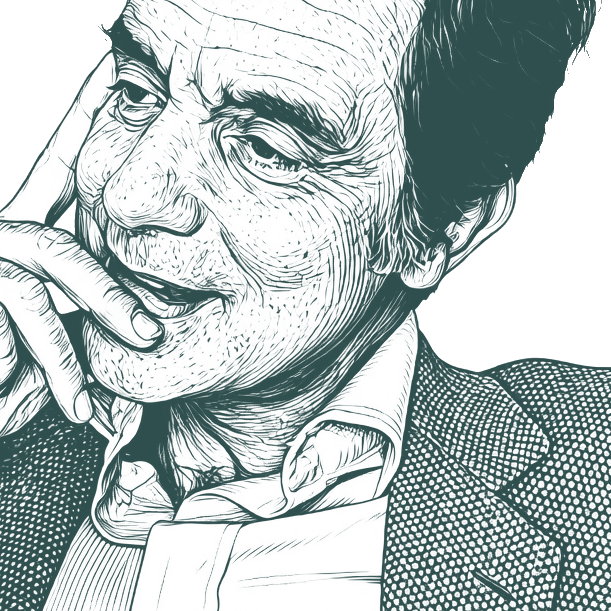
Italo Calvino (October 15, 1923 – September 19, 1985) was an Italian journalist and writer of short stories and novels. Lionized in Britain and America, he was, at the time of his death, the most-translated contemporary Italian writer.
Biography information from
Wikiquote·
Portrait adapted from
Wikimedia Commons, The original uploader was Varie11 at Italian Wikipedia. (Public domain / CC0)
Also Known As
Alternative Names:
Italo Giovanni Calvino
•
Italo Giovanni Calvino Mameli
Now the situation is different, I admit: I have a wristwatch, I compare the angle of its hands with the angle of all the hands I see; I have an engagement book where the hours of my business appointments are marked down; I have a chequebook on whose stubs I add and subtract numbers. At Penn Station I get off the train, I take the subway, I stand and grasp the strap with one hand to keep my balance while I hold the newspaper up in the other, folded so I can glance over the figures of the stock market quotations: I play the game, in other words, the game of pretending there's an order in the dust, a regularity in the system, or an interpretation of different systems, incongruous but still measurable, so that every graininess of disorder coincides with the faceting of an order which promptly crumbles.
Something must always remain that eludes us ... For power to have an object on which it can be exercised, a space in which to stretch out its arms ... As long as I know there exists in the world someone who does tricks only for the love of the trick, as long as I know there is a woman who loves reading for reading's sake, I can convince myself that the world continues ... And every evening I, too, abandon myself to reading, like that distant unknown woman ....
If a lover is wretched who invokes kisses of which he knows not the flavor, a thousand times more wretched is he who has had a taste of the flavor and then had it denied him.