Works in ChatGPT, Claude, or Any AI
Add semantic quote search to your AI assistant via MCP. One command setup.
" "Things are not more or less perfect, according as they delight or offend human senses, or according as they are serviceable or repugnant to mankind.
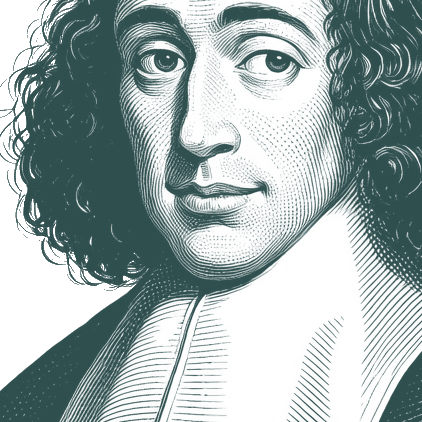
Benedictus de Spinoza (24 November 1632 – 21 February 1677) was a social and metaphysical philosopher known for the elaborate development of his monist philosophy, which has become known as Spinozism. Controversy regarding his ideas led to his excommunication from the Jewish community of his native Amsterdam. He was named Baruch ("blessed" in Hebrew) Spinoza by his synagogue elders and known as Bento de Spinoza or Bento d'Espiñoza, but afterwards used the name Benedictus ("blessed" in Latin) de Spinoza.
Biography information from Wikiquote
Add semantic quote search to your AI assistant via MCP. One command setup.
Related quotes. More quotes will automatically load as you scroll down, or you can use the load more buttons.
But how to write about a man who lived such a contemplative life marked by so few striking external events? He was extraordinarily private, and he kept his own person invisible in his writing. I had none of the material that ordinarily lends itself to narrative—no family dramas, no love affairs, jealousies, curious anecdotes, feuds, spats, or reunions. He had a large correspondence, but after his death his colleagues followed his instructions and removed almost all personal comments from his letters. No, not much external drama in his life: most scholars regard Spinoza as a placid and gentle soul—some compare his life to that of Christian saints, some even to Jesus.
Chat naturally about what you need. Each answer links back to real quotes with citations.
While it is patently not the case that key figures such as d'Holbach and Condorcet delved deeply into Spinoza's thought, or cited him often or in some cases ever, at the same time, one must acknowledge that the key elements constituting High Enlightenment French ‘Spinozisme’ in the sense intended here were not discovered or concocted by these post-1740 writers and thinkers but were transmitted to them by those sections of the pre-1730 radical philosophical underground literature, especially clandestine manuscripts and suppressed printed books, that were more directly immersed in Spinoza's own texts and thought. Those who performed this bridging role transmitting the basic elements of ‘Spinozism’ to the generation of Diderot and d'Holbach consisted of two distinct coteries. On the one hand there were those English ‘deists’, Toland, Tindal and Collins especially, who rejected Locke's dualism and principle of ‘supra rationem’ and adopted instead seemingly directly from, or else in emulation of, Spinoza, the latter’s one-substance doctrine based on the idea that motion is inherent in matter, his necessitarianism, anti-Scripturalism and attack on ‘priestcraft’ along with his plea for full freedom of conscience and expression, or ‘freedom to philosophize’. Secondly, there were a group of subversive Huguenot and other French thinkers in the years around 1700, and down to the 1730s, whether or not they themselves can accurately be called ‘Spinozists’, who were deeply preoccupied with Spinoza's texts and bequeathed a powerful philosophical impetus to the generation of Diderot and d'Holbach. Especially important for the transmission of Spinozist ideas in France, and the literary depicting of an underground sect of ‘Spinozists’ pervading the whole of European culture, were Bayle, Boulainvilliers, and d'Argens but there were many others in this group, Tyssot de Patot among them.