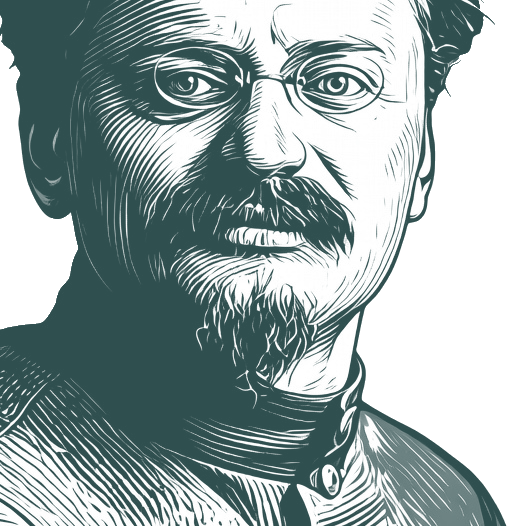
Both theoretical analysis as well as the rich historical experience of the last quarter of a century have demonstrated with equal force that fascism … - Leon Trotsky
""
Both theoretical analysis as well as the rich historical experience of the last quarter of a century have demonstrated with equal force that fascism is each time the final link of a specific political cycle composed of the following: the gravest crisis of capitalist society; the growth of the radicalization of the working class; the growth of sympathy toward the working class, and a yearning for change on the part of the rural and urban petty bourgeoisie; the extreme confusion of the big bourgeoisie; its cowardly and treacherous maneuvers aimed at avoiding the revolutionary climax; the exhaustion of the proletariat; growing confusion and indifference; the aggravation of the social crisis; the despair of the petty bourgeoisie, its yearning for change; the collective neurosis of the petty bourgeoisie, its readiness to believe in miracles, its readiness for violent measures; the growth of hostility towards the proletariat, which has deceived its expectations. These are the premises for a swift formation of a fascist party and its victory.
Leon Trotsky (Лев Давидович Троцкий; born Lev Davidovich Bronstein; Лев Давидович Бронштейн]; 7 November (O.S. 26 October) 1879 – 21 August 1940) was a Russian Marxist, intellectual, and revolutionary. In the early Soviet Union, he founded the Politburo, served as People's Commissar for Foreign Affairs, and created and led the Red Army. After Lenin's death, Trotsky was exiled for his opposition to Joseph Stalin's policies. His 1940 assassination (with an ice axe) in Mexico was carried out by a Soviet agent (Ramón Mercader) at Stalin's behest.
Pen Names:
Троцкий
•
Перо
•
Антид Ото
•
Л. Седов
•
Старик
Native Name:
Лейба Давидович Бронштейн
•
Лев Давидович Троцкий
Alternative Names:
Lev Bronstein
•
Lev Davidovich Bronshtein
•
Lev Davidovich Bronstein
•
Leon Trotski
•
Trotsky
•
Lev Davidovich Bronshteyn
•
Lev Bronshteyn
•
Lev Trotsky
•
Trotskiy
•
Lev Trotskiy
•
Lev Davidovich Trotsky
•
Lev Davidovich Trotskiy
Thousands and thousands of books are thrown on the market every year presenting some new variant of the personal romance, some tale of the vacillations of the melancholic or the career of the ambitious. The heroine of Proust requires several finely-wrought pages in order to feel that she does not feel anything. It would seem that one might, at least with equal justice, demand attention to a series of collective historic dramas which lifted hundreds of millions of human beings out of nonexistence, transforming the character of nations and intruding forever into the life of all mankind.
Literature without the power of great synthesis is the symptom of social weariness and is characteristic of sharply transitional epochs.
PREMIUM FEATURE
Advanced Search Filters
Filter search results by source, date, and more with our premium search tools.
"A program of "disarmament," while imperialist antagonisms survive, is the most pernicious of fictions. Even if it were realized by way of general agreement - an obviously fantastic assumption!- that would by no means prevent a new war. The imperialists do not make war because there are armaments; on the contrary, they forge arms when they need to fight."