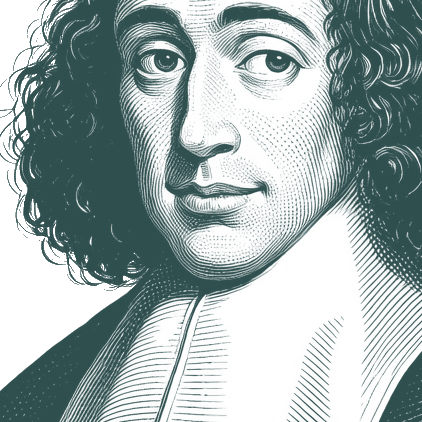
dulce, que la libertad, he creído hacer una buena obra, y de alguna utilidad, tal vez, enseñando que la libertad de pensar, no tan sólo puede concili… - Benedictus de Spinoza
""
dulce, que la libertad, he creído hacer una buena obra, y de alguna utilidad, tal vez, enseñando que la libertad de pensar, no tan sólo puede conciliarse con la paz y salvación del estado, sino que no puede destruirse sin destruir al mismo tiempo esa paz del estado y la piedad misma. He aquí lo principal que yo he deseado establecer en este tratado. (TTP Praef.)
Spanish
Collect this quote
About
Benedictus de Spinoza
Benedictus de Spinoza (24 November 1632 – 21 February 1677) was a social and metaphysical philosopher known for the elaborate development of his monist philosophy, which has become known as Spinozism. Controversy regarding his ideas led to his excommunication from the Jewish community of his native Amsterdam. He was named Baruch ("blessed" in Hebrew) Spinoza by his synagogue elders and known as Bento de Spinoza or Bento d'Espiñoza, but afterwards used the name Benedictus ("blessed" in Latin) de Spinoza.
Native Name:
בָּרוּךְ שְׂפִּינוֹזָה
•
Benedito de Espinosa
Alternative Names:
Benedict de Spinoza
•
Baruch de Espinosa
•
Barukh Shpinozah
•
Benoît de Spinoza
•
Sbīnūzā
•
Ispīnūzā
•
Barukh Spinoza
•
Bento de Espinosa
•
Baruch d' Espinoza
•
Shpinozah
•
Baruch de Spinoza
•
Spinoza
•
Benoit de Spinoza
•
Benedictus De Spinoza
•
Benedictus Spinoza
•
Baruch Spinoza
•
Baruch Benedictus de Spinoza
...The more a man knows about individual objects, the more he knows about God. Translating Spinoza's language into ours, we can say: The more a man knows about himself in relation to every kind of experience, the greater his chance of suddenly, one fine morning, realizing who in fact he is...
The political ideal that Spinoza promotes in the Theological-Political Treatise is a secular, democratic commonwealth, one that is free from meddling by ecclesiastics. Spinoza is one of history's most eloquent advocates for freedom and toleration. The ultimate goal of the Treatise is enshrined in both the book's subtitle and in the argument of its final chapter: to show that ‘freedom to philosophise may not only be allowed without danger to piety and the stability of the republic, but that it cannot be refused without destroying the peace of the republic and piety itself’.
Go Premium
Support Quotewise while enjoying an ad-free experience and premium features.
While Schelling was wrestling with Plato, Spinoza, and Kant, his contemporary Hegel was struggling with Spinoza exclusively. In Hegel, Spinoza reached the height of his influence upon the German mind. Hegel was the most influential, although not the most original, German philosopher since the days of Kant. His system was more an absorption of other systems than an original creation. Therein lies the secret of his influence. He brought all the philosophical tendencies and moods of his time to a conclusion. With him the pantheism of his period attained its highest development and became the conscious and necessary connection of the mind and the world. During his entire philosophical career, Hegel constantly wrestled with Spinoza and for a time was entirely in his clutches. It was while under this influence that Hegel said that in order to refute Spinoza one must first accept him. In his lectures on the history of philosophy he says, "That Spinoza is the main point in modern philosophy, it is either Spinozism or no philosophy at all." He defended Spinoza against the reproach that his philosophy was atheistic and destructive of morality. In his later years, however, when he became more conservative, he changed his attitude toward Spinoza. He said, "that the philosophy of the "Amsterdam hermit" was an antiquated point of view, that his method was 'wooden,' that his proofs were formal tortures, that the attributes did not emanate from the substance and that the modi did not emanate from the attributes." But it was reserved for his old age to discover that Spinozism was philosophically objectionable because it did not tally with Christianity.