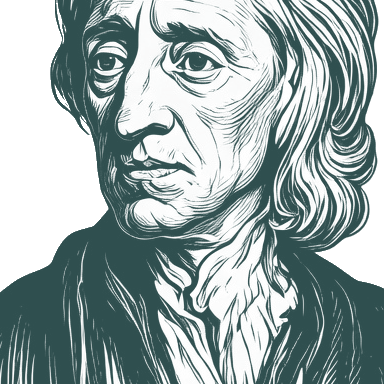
John Locke (29 August 1632 – 28 October 1704) was an influential English philosopher and social contract theorist. He developed an alternative to the Hobbesian state of nature and asserted a government could be good only if it received the consent of the governed and protected the natural rights of life, liberty, and estate. If such a consent was not achieved, Locke argued in favour of a right of rebellion, which he referred to as an "appeal to heaven".
Biography information from
Wikiquote·
Portrait adapted from
Wikimedia Commons, Godfrey Kneller (Public domain / CC0)
The end of law is not to abolish or restrain, but to preserve and enlarge freedom.
But since the great foundation of fear in children is pain, the way to harden and fortify children against fear and danger is to accustom them to suffer pain.
PREMIUM FEATURE
Advanced Search Filters
Filter search results by source, date, and more with our premium search tools.
"government being for the preservation of every man's right and property, by preserving him from the violence or injury of others, is for the good of the governed : for the magistrate's sword being for a "terror to evil doers," and by that terror to enforce men to observe the positive laws of the society, made conformable to the laws of nature, for the public good, i. e. the good of every particular member of that society, as far as by common rules it can be provided for; the sword is not given the magistrate for his own good alone."