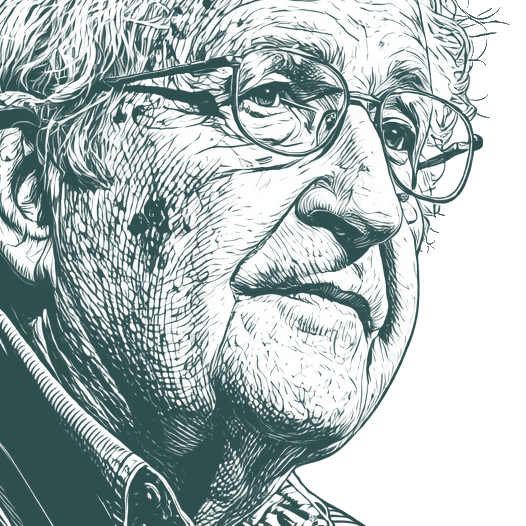
...if you ask me whether or not I'm an atheist, I wouldn't even answer. I would first want an explanation of what it is that I'm supposed not to beli… - Noam Chomsky

" "

...if you ask me whether or not I'm an atheist, I wouldn't even answer. I would first want an explanation of what it is that I'm supposed not to believe in, and I've never seen an explanation.

English
Collect this quote

About Noam Chomsky

Avram Noam Chomsky (born 7 December 1928) is an American linguist, analytical philosopher, cognitive scientist, political analyst, human rights activist and anarcho-socialist.

Biography information from Wikiquote

Also Known As

Birth Name: Avram Noam Chomsky
Alternative Names: A. Noam Chomsky Chomsky
Try QuoteGPT

Chat naturally about what you need. Each answer links back to real quotes with citations.

Related quotes. More quotes will automatically load as you scroll down, or you can use the load more buttons.

Additional quotes by Noam Chomsky

In my own professional work I have touched on a variety of different fields. I’ve done work in mathematical linguistics, for example, without any professional credentials in mathematics; in this subject I am completely self-taught, and not very well taught. But I’ve often been invited by universities to speak on mathematical linguistics at mathematics seminars and colloquia. No one has ever asked me whether I have the appropriate credentials to speak on these subjects; the mathematicians couldn’t care less. What they want to know is what I have to say. No one has ever objected to my right to speak, asking whether I have a doctor’s degree in mathematics, or whether I have taken advanced courses in the subject. That would never have entered their minds. They want to know whether I am right or wrong, whether the subject is interesting or not, whether better approaches are possible… the discussion dealt with the subject, not with my right to discuss it.
But on the other hand, in discussion or debate concerning social issues or American foreign policy…. The issue is constantly raised, often with considerable venom. I’ve repeatedly been challenged on grounds of credentials, or asked, what special training do I have that entitles you to speak on these matters. The assumption is that people like me, who are outsiders from a professional viewpoint, are not entitled to speak on such things.
Compare mathematics and the political sciences… it’s quite striking. In mathematics, in physics, people are concerned with what you say, not with your certification. But in order to speak about social reality, you must have the proper credentials, particularly if you depart from the accepted framework of thinking. Generally speaking, it seems fair to say that the richer the intellectual substance of a field, the less there is a concern for credentials, and the greater is the concern for content.

In Somalia, we know exactly what they had to gain because they told us. The chairman of the Joint Chiefs, Colin Powell, described this as the best public relations operation of the Pentagon that he could imagine. His picture, which I think is plausible, is that there was a problem about raising the Pentagon budget, and they needed something that would be, look like a kind of a cakewalk, which would give a lot of prestige to the Pentagon. Somalia looked easy. Let's look back at the background. For years, the United States had supported a really brutal dictator, who had just devastated the country, and was finally kicked out. After he's kicked out, it was 1990, the country sank into total chaos and disaster, with starvation and warfare and all kind of horrible misery. The United States refused to, certainly to pay reparations, but even to look. By the middle of 1992, it was beginning to ease. The fighting was dying down, food supplies were beginning to get in, the Red Cross was getting in, roughly 80% of their supplies they said. There was a harvest on the way. It looked like it was finally sort of settling down. At that point, all of a sudden, George Bush announced that he had been watching these heartbreaking pictures on television, on Thanksgiving, and we had to do something, we had to send in humanitarian aid. The Marines landed, in a landing which was so comical, that even the media couldn't keep a straight face. Take a look at the reports of the landing of the Marines, it must've been the first week of December 1992. They had planned a night, there was nothing that was going on, but they planned a night landing, so you could show off all the fancy new night vision equipment and so on. Of course they had called the television stations, because what's the point of a PR operation for the Pentagon if there's no one to look for it. So the television stations were all there, with their bright lights and that sort of thing, and as the Marines were coming ashore they were blinded by the television light. So they had to send people out to get the cameramen to turn off the lights, so they could land with their fancy new equipment.

Go Premium

Support Quotewise while enjoying an ad-free experience and premium features.

View Plans
Loading...