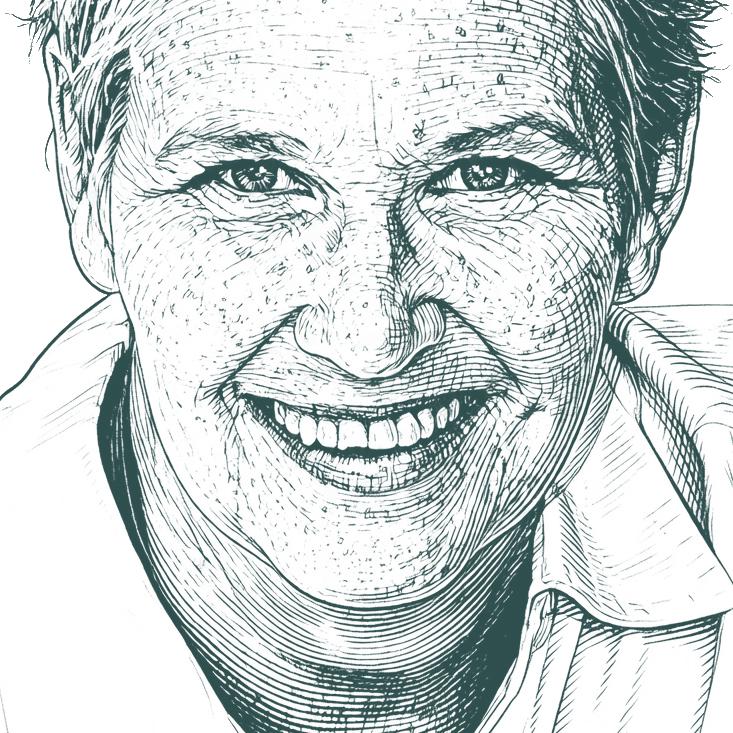
Putting a book together is interesting and exhilarating. It is sufficiently difficult and complex and it engages all your intelligence. It is life at… - Annie Dillard
""
Putting a book together is interesting and exhilarating. It is sufficiently difficult and complex and it engages all your intelligence. It is life at its most free. Your freedom as a writer is not freedom of expression in the sense of wild blurting; you may not let it rip. It is life at its most free, if you are fortunate enough to be able to try it, because you select your materials, invent your task, and pace yourself.
Annie Dillard (born 30 April 1945) is an American author born in Pittsburgh, Pennsylvania. She won the Pulitzer Prize for her non-fiction narrative Pilgrim at Tinker Creek in 1974. She has since published ten other books. Her most recent is the novel The Maytrees (June 2007).
Biography information from
Wikiquote·
Portrait adapted from
Wikimedia Commons, Photo by Phyllis Rose (CC BY-SA)
Last year I had a very unusual experience. I was awake, with my eyes closed, when I had a dream. It was a small dream about time. I was dead, I guess, in deep black space high up among many white stars. My own consciousness had been disclosed to me, and I was happy. Then I saw far below me a long, curved band of color. As I came closer, I saw that it stretched endlessly in either direction, and I understood that I was seeing all the time of the planet where I had lived.
It looked like a woman’s tweed scarf; the longer I studied any one spot, the more dots of color I saw. There was no end to the deepness and variety of the dots. At length, I started to look for my time, but, although more and more specks of color and deeper and more intricate textures appeared in the fabric, I couldn’t find my time, or any time at all that I recognized as being near my time. I couldn’t make out so much as a pyramid. Yet as I looked at the band of time, all the individual people, I understood with special clarity, were living at the very moment with great emotion, in intricate detail, in their individual times and places, and they were dying and being replaced by ever more people, one by one, like stitches in which whole worlds of feeling and energy were wrapped, in a never-ending cloth. I remembered suddenly the color and texture of our life as we knew it- these things had been utterly forgotten- and I thought as I searched for it on the limitless band, “that was a good time then, a good time to be living.”
And I began to remember our time. I recalled green fields with carrots growing, one by one, in slender rows. Men and women in bright vests and scarves came and pulled the carrots out of the soil and carried them in baskets to shaded kitchens, where they scrubbed them with yellow brushes under running water…I saw may apples in forest, erupting through leaf-strewn paths. Cells on the root hairs of sycamores split and divided and apples grew striped and spotted in the fall.
Skin was earth; it was soil. I could see, even on my own skin, the joined trapezoids of dust specks God had wetted and stuck with his spit the morning he made Adam from dirt. Now, all these generations later, we people could still see on our skin the inherited prints of the dust specks of Eden.
Works in ChatGPT, Claude, or Any AI
Add semantic quote search to your AI assistant via MCP. One command setup.
Is it not late? A late time to be living? Are not our generations the crucial ones? For we have changed the world. Are not our heightened times the important ones? For we have nuclear bombs. Are we not especially significant because our century is? - our century and its unique Holocaust, its refugee populations, its serial totalitarian exterminations; our century and its antibiotics, silicon chips, men on the moon, and spliced genes? No, we are not and it is not. These times of ours are ordinary times, a slice of life like any other. Who can bear to hear this, or who will consider it?...
Take away the bomb threat and what are we? Ordinary beads on a never-ending string. Our time is a routine twist of an improbable yarn...There must be something heroic about our time, something that lifts it above all those other times. Plague? Funny weather? Dire things are happening... Why are we watching the news, reading the news, keeping up with the news? Only to enforce our fancy - probably a necessary lie - that these are crucial times, and we are in on them. Newly revealed, and we are in the know: crazy people, bunches of them. New diseases, shifts in power, floods! Can the news from dynastic Egypt have been any different?