"None of us constitutes a material whole, identical for everyone, which a person has only to go look up as though we were a book of specifications or… - Marcel Proust
"None of us constitutes a material whole, identical for everyone, which a person has only to go look up as though we were a book of specifications or a last testament; our social personality is a creation of the minds of others. Even the very simple act that we call "seeing a person we know" is in part an intellectual one. We fill the physical appearance of the individual we see with all the notions we have about him, and of the total picture that we form for ourselves, these notions certainly occupy the greater part."
Valentin Louis Georges Eugène Marcel Proust (10 July 1871 – 18 November 1922) was a French novelist, essayist and critic.
Biography information from
Wikiquote·
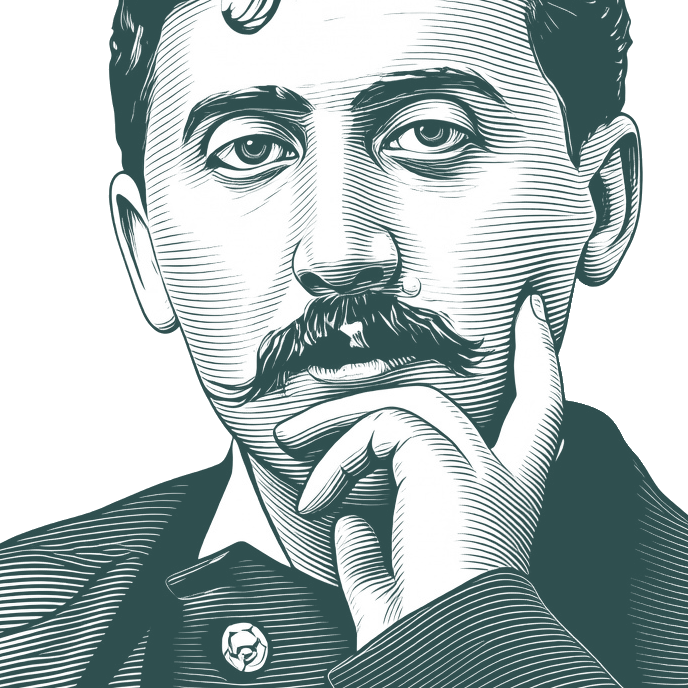
Portrait adapted from
Wikimedia Commons, Otto Wegener (Public domain / CC0)
Also Known As
Alternative Names:
Valentin Louis Georges Eugène Marcel Proust
•
Proust
•
Valentin Louis Georges Eugéne Marcel Proust
•
Valentin-Louis-Georges-Eugéne-Marcel Proust
•
Valentin Louis Georges Eugene Marcel Proust
•
Valentin-Louis-Georges-Eugene-Marcel Proust
•
Bernard d'Algouvres
•
Valentin-Louis-Georges-Eugène-Marcel Proust
The reality that I had known no longer existed. The places that we have known belong now only to the little world of space on which we map them for our own convenience. None of them was ever more than a thin slice, held between the contiguous impressions that composed our life at that time; remembrance of a particular form is but regret for a particular moment; and houses, roads, avenues are as fugitive, alas, as the years.
It is not only by dint of lying to others, but also of lying to ourselves, that we cease to notice that we are lying.
Enhance Your Quote Experience
Enjoy ad-free browsing, unlimited collections, and advanced search features with Premium.
Poets claim that we recapture for a moment the self that we were long ago when we enter some house or garden in which we used to live in our youth. But these are most hazardous pilgrimages, which end as often in disappointment as in success. It is in ourselves that we should rather seek to find those fixed places, contemporaneous with different years. And great fatigue followed by a good night's rest can to a certain extent help us to do so. For in order to make us descend into the most subterranean galleries of sleep, where no reflexion from overnight, no gleam of memory comes to light up the interior monologue — if the latter does not itself cease — fatigue followed by rest will so thoroughly turn over the soil and penetrate the bedrock of our bodies that we discover down there, where our muscles plunge and twist in their ramifications and breathe in new life, the garden where we played in our childhood. There is no need to travel in order to see it again; we must dig down inwardly to discover it. What once covered the earth is no longer above but beneath it; a mere excursion does not suffice for a visit to the dead city: excavation is necessary also. But we shall see how certain fugitive and fortuitous impressions carry us back even more effectively to the past, with a more delicate precision, with a more light-winged, more immaterial, more headlong, more unerring, more immortal flight, than these organic dislocations.