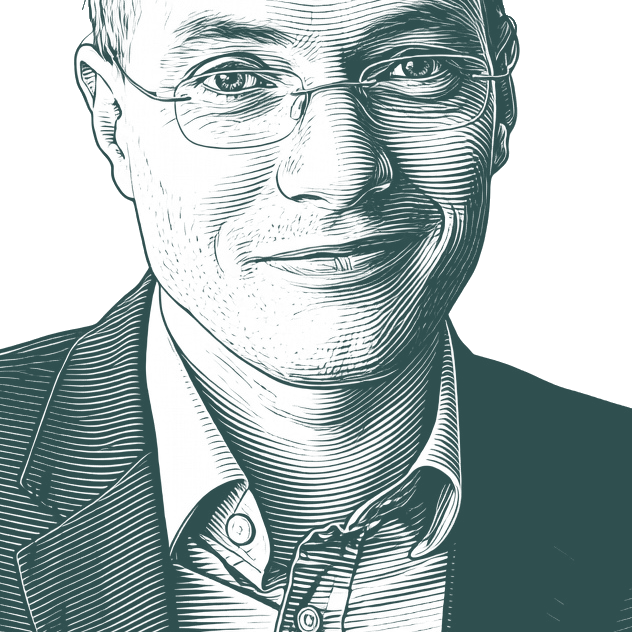
Swiss-born British philosopher and writer
Alain de Botton (born 20 December 1969) is a Swiss-born British philosopher and author. His books and television programs discuss various contemporary subjects and themes in a philosophical style, emphasizing philosophy's relevance to everyday life. De Botton comes from a Sephardic Jewish family, originating from a small Castilian town of Boton (now vanished) on the Iberian peninsula.
Bio from: Wikiquote (CC BY-SA 4.0) · Portrait adapted from: Wikimedia Commons, Fronteiras do Pensamento (CC BY-SA)
From Wikidata (CC0)
Works in ChatGPT, Claude, or Any AI
Add semantic quote search to your AI assistant via MCP. One command setup.
We might imagine that the fear and insecurity of getting close to someone would happen only once, at the start of a relationship, and that anxieties couldn’t possibly continue after two people had made some explicit commitments to one another, like marrying, securing a joint mortgage, buying a house, having a few children, and naming each other in their wills. Yet conquering distance and gaining assurances that we are needed aren’t exercises to be performed only once; they have to be repeated every time there’s been a break — a day away, a busy period, an evening at work — for every interlude has the power once again to raise the question of whether or not we are still wanted.
It is the most ambitious and driven among us who are the most sorely in need of having our reckless hopes dampened through immersive dousings in the darkness which religions have explored. This is a particular priority for secular Americans, perhaps the most anxious and disappointed people on earth, for their nation infuses them with the most extreme hopes about what they may be able to achieve in their working lives and relationships.
Enhance Your Quote Experience
Enjoy ad-free browsing, unlimited collections, and advanced search features with Premium.
Confident that cast-iron walls separate our nature and situation from theirs, comfortable in the well-broken-in saddle of our high horse, we have exchanged our capacity to be tolerant for detachment and derision.
It is the tragedian's task, then, to force us to confront an almost unbearable truth: every folly or myopia of which any human being in history has been guilty may be traced back to some aspect of our collective nature. Because we each bear within ourselves the whole of the human condition, in its worst and best aspects, any one of us might be capable of doing anything at all, or nothing, under the right — or rather the most horribly wrong — conditions.
Love reinvents our needs with unique speed. My impatience with the customs ritual indicated that Chloe, who I had not known existed a few hours ago, had already acquired the status of a craving. I felt I would die if I missed her outside – die for the sake of someone who had only entered my life at eleven thirty that morning.
Nowhere was the airport's charm more concentrated than on the screens placed at intervals across the terminal which announced, in deliberately workmanlike fonts, the itineraries of aircraft about to take to the skies. These screens implied a feeling of infinite and immediate possibility: they suggested the ease with which we might impulsively approach a ticket desk and, within a few hours, embark for a country where the call to prayer rang out over shuttered whitewashed houses, where we understood nothing of the language and where no one knew our identities.