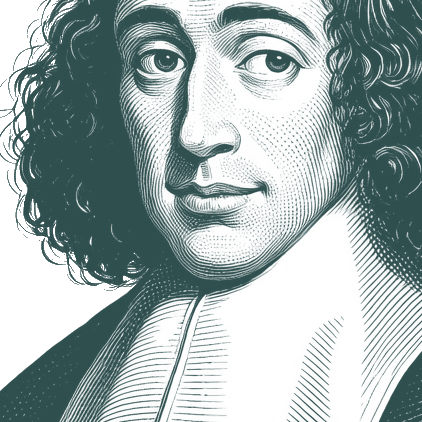
According to the seventeenth-century way of thinking, an atheist was by definition a decadent. If there was no God (or, at least, no providential, re… - Benedictus de Spinoza
""
According to the seventeenth-century way of thinking, an atheist was by definition a decadent. If there was no God (or, at least, no providential, rewarding-and-punishing God of the sort worshipped in all the traditional religions), the reasoning went, then everything is permitted. So a non-beliver would be expected to indulge in all manner of sensual stimulation... to lie, cheat, and steal... Spinoza, according to all seventeenth-century interpreters, rejected all the traditional ideas about God; he was indesputably a heretic. Yet his manner of living was humble and apparently free of vice. Then, as now, the philosopher seemed a living oxymoron: he was an ascetic sensualist, a spiritual materialist, a sociable hermit, a secular saint. How could his life have been so good, the critics asked, when his philosophy was so bad?
English
Collect this quote
About
Benedictus de Spinoza
Benedictus de Spinoza (24 November 1632 – 21 February 1677) was a social and metaphysical philosopher known for the elaborate development of his monist philosophy, which has become known as Spinozism. Controversy regarding his ideas led to his excommunication from the Jewish community of his native Amsterdam. He was named Baruch ("blessed" in Hebrew) Spinoza by his synagogue elders and known as Bento de Spinoza or Bento d'Espiñoza, but afterwards used the name Benedictus ("blessed" in Latin) de Spinoza.
Native Name:
בָּרוּךְ שְׂפִּינוֹזָה
•
Benedito de Espinosa
Alternative Names:
Benedict de Spinoza
•
Baruch de Espinosa
•
Barukh Shpinozah
•
Benoît de Spinoza
•
Sbīnūzā
•
Ispīnūzā
•
Barukh Spinoza
•
Bento de Espinosa
•
Baruch d' Espinoza
•
Shpinozah
•
Baruch de Spinoza
•
Spinoza
•
Benoit de Spinoza
•
Benedictus De Spinoza
•
Benedictus Spinoza
•
Baruch Spinoza
•
Baruch Benedictus de Spinoza
This sets us off on a path which was opened for us almost without our knowledge, I think, for we have not really considered it, by two philosophers in history: Spinoza and Marx. Against what should really be called the latent dogmatic empiricism of Cartesian idealism, Spinoza warned us that the object of knowledge or essence was in itself absolutely distinct and different from the real object, for, to repeat his famous aphorism, the two objects must not be confused: the idea of the circle, which is the object of knowledge must not be confused with the circle, which is the real object. In the third chapter of the 1857 Introduction, Marx took up this principle as forcefully as possible. Marx rejected the Hegelian confusion which identifies the real object with the object of knowledge, the real process with the knowledge process: ‘Hegel fell into the illusion of conceiving the real (das Reale) as the result of thought recapitulating itself within itself deepening itself within itself and moving itself from within itself whereas the method that allows one to rise from the abstract to the concrete is merely the mode (die Art) of thought which appropriates the concrete and reproduces (reproduzieren) it as a spiritual concrete (geistig Konkretes)’ (Grundrisse der Kritik der Politischen Ökonomie, Berlin 1953, p. 22). This confusion, which in Hegel takes the form of an absolute idealism of history, is in principle simply a variant of the confusion which characterizes the problematic of empiricism.
The philosophy of Spinoza has replaced both Marxism and capitalist neo-liberalism. While affected timelessness is inherent in the Hardt-Negri rhetoric – hence their over-easy references to antiquity or the Middle Ages – the centre of gravity in this book is firmly in the later 17th century. Once regarded as an important precursor of the Enlightenment and of Marxist materialism, the thought of Spinoza (1632–77) is redeemed in these pages, as a wisdom awaiting its vindication in a globalised epoch yet to come. In vital ways, Spinoza told the whole story: his apparently abstract pantheistic philosophy explained history itself, future as well as past, and the globalisation process simply favours a return to such understanding, after the mounting sorrows and delusions of modernity.
Works in ChatGPT, Claude, or Any AI
Add semantic quote search to your AI assistant via MCP. One command setup.
To us it seems that this difference, which Spinoza's thought constitutes in the history of Western metaphysics, represents an extremely high point of the theoretical development of modern thought. In other words, Spinoza's thought seems to us to represent a strategy for superseding the antinomies of bourgeois thought. But because bourgeois ideology is essentially based on antinomies, this supersession is a supersession tout court of the ideology. Spinoza gives us being in its immediateness. He destroys the homology between the mediations of articulations of being and the mediations and articulations of bourgeois Power. He presents us with the world as a territory of a joyous construction of immediate human needs.