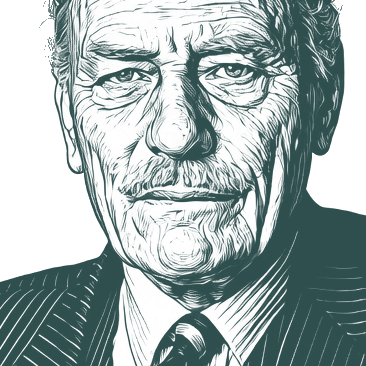
Yet even though that picture is dark and darkening, there is one factor which has not yet been injected. I do not know whether it will be tomorrow, o… - Enoch Powell
""
Yet even though that picture is dark and darkening, there is one factor which has not yet been injected. I do not know whether it will be tomorrow, or next year, or in five years; but it will come. That factor is firearms and explosives. With communities which are so divided nothing can prevent the injection of explosives which we know perfectly well from experience in other parts of the United Kingdom and the world. At first there will be horrified astonishment, and inquiry as to what we have done wrong that such things should be happening. Then there will be feverish endeavour to find methods to allay the supposed grievances which lie behind the violence. Then follows exploitation by those who use violence of the ascendancy they have thus gained over the majority and over authority. The thing goes forward, acting and reacting, until a position is reached in which—I shall dare say it—compared with those areas, Belfast today will seem an enviable place.
John Enoch Powell (16 June 1912 – 8 February 1998) was a British politician, classical scholar, author, linguist, soldier, philologist, and poet. He served as a Conservative Member of Parliament (1950–1974), then Ulster Unionist Party (UUP) MP (1974–1987), and was Minister of Health (1960–1963).
Compassion is something individual and voluntary. You cannot compel somebody to be compassionate; nor can you be vicariously compassionate by compelling somebody else. The Good Samaritan would have lost all merit if a Roman soldier were standing by the road with a drawn sword, telling him to get on with it and look after the injured stranger. Because there can be no such thing as compulsory compassion or vicarious compassion, therefore it is a humbugging abuse of language, intended to deceive, to talk about a 'compassionate Government' or a 'compassionate party'—or even a 'compassionate society', unless one simply means by that a society which happens to contain a lot of compassionate individuals. Nor let anyone protest: 'Oh, but when I vote for a party which will "make provision on an unprecedented scale for those in need of help", it means I too shall have to pay my whack and so I am being compassionate after all'. Nonsense! The purpose of your vote is not to make yourself subscribe—that you can freely do at any time—but to compel others.
I [also] know that, on my deathbed, I shall still be believing with one part of my brain that somewhere on every ocean of the world there is a grey, grey ship with three funnels and sixteen-inch guns which can blow out of the water any other navy which is likely to face it. I know it is not so. Indeed, I realised at a relatively early age that it is not so. But that factor – that emotional factor... will not die until I, the carrier of it, am dead.
Go Premium
Support Quotewise while enjoying an ad-free experience and premium features.
To tell the indigenous inhabitants of Brixton or Southall or Leicester or Bradford or Birmingham or Wolverhampton, to tell the pensioners ending their days in streets of nightly terror unrecognisable as their former neighbourhoods, to tell the people of towns and cities where whole districts have been transformed into enclaves of foreign lands, that "the man with a coloured face could be an enrichment to my life and that of my neighbours" is to drive them beyond the limits of endurance. It is not so much that it is obvious twaddle. It is that it makes cruel mockery of the experience and fears of hundreds of thousands, if not millions, of ordinary, decent men and women...In understanding this matter, the beginning of wisdom is to grasp the law that in human societies power is never left unclaimed and unused...Men's nature is not only, as Thucydides long ago asserted, to exert power where they have it: men cannot help themselves from exerting power where they have it, whether they want to or not...It is the business of the leaders of distinct and separate populations to see that the power which they possess is used to benefit those for whom they speak. Leaders who fail to do so, or to do so fast enough, find themselves outflanked and superseded by those who are less squeamish. The Gresham's Law of extremism, that the more extreme drives out the less extreme, is one of the basic rules of political mechanics which operate in this field...Both the general law and its Gresham's corollary point, in contemporary circumstances, towards the resort to physical violence, in the form of firearms or high explosive, as being so probable as to be predicted with virtual certainty. The experience of the last decade and more, all round the world, shows that acts of violence, however apparently irrational or inappropriate their targets, precipitate a frenzied search on the part of the society attacked to discover and remedy more and more grievances, real or imaginary, among those from whom the violence is supposed to emanate or on whose behalf it is supposed to be exercised. Those commanding a position of political leverage would then be superhuman if they could refrain from pointing to the acts of terrorism and, while condemning them, declaring that further and faster concessions and grants of privilege are the only means to avoid such acts being repeated on a rising scale. This is what produces the gearing effect of terrorism in the contemporary world, yielding huge results from acts of violence perpetrated by minimal numbers. It is not, I repeat again and again, that the mass of a particular population are violently or criminally disposed. Far from it; that population soon becomes itself the prisoner of the violence and machinations of an infinitely small minority among it. Just a few thugs, a few shots, a few bombs at the right place and time – and that is enough for disproportionate consequences to follow.