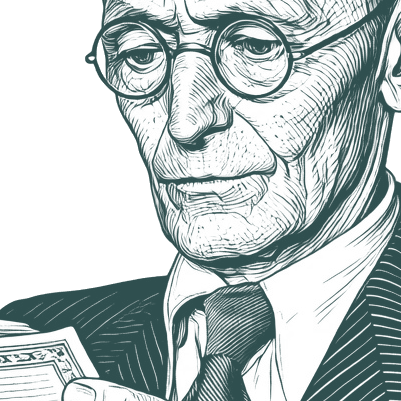
He lost his Self a thousand times and for days on end he dwelt in non-being. But although the paths took him away from Self, in the end they always l… - Hermann Hesse
""
He lost his Self a thousand times and for days on end he dwelt in non-being. But although the paths took him away from Self, in the end they always led back to it. Although Siddhartha fled from the Self a thousand times, dwelt in nothing, dwelt in animal and stone, the return was inevitable; the hour was inevitable when he would again find himself in sunshine or in moonlight, in shadow or in rain, and was again Self and Siddhartha, again felt the torment of the onerous life cycle.
Hermann Karl Hesse (2 July 1877 – 9 August 1962) was a German-Swiss poet, novelist, and painter. In 1946, he received the Nobel Prize in Literature. His most famous works include Steppenwolf, Siddhartha, and The Glass Bead Game (also known as Magister Ludi) all of which explore an individual's search for spirituality.
Siddhartha … had begun to suspect that his worthy father and his other teachers, the wise Brahmins, had already passed on to him the bulk and best of their wisdom, that they had already poured the sum total of their knowledge into his waiting vessel; and the vessel was not full, his intellect was not satisfied.
Then came those years in which I was forced to recognize the existence of a drive within me that had to make itself small and hide from the world of light. The slowly awakening sense of my own sexuality overcame me, as it does every person, like an enemy and terrorist, as something forbidden, tempting, and sinful. What my curiosity sought, what dreams, lust and fear created — the great secret of puberty — did not fit at all into my sheltered childhood. I behaved like everyone else. I led the double life of a child who is no longer a child. My conscious self lived within the familiar and sanctioned world; it denied the new world that dawned within me. Side by side with this I lived in a world of dreams, drives and desires of a chthonic nature, across which my conscious self desperately built its fragile bridges, for the childhood world within me was falling apart. Like most parents, mine were no help with the new problems of puberty, to which no reference was ever made. All they did was take endless trouble in supporting my hopeless attempts to deny reality and to continue dwelling in a childhood world that was becoming more and more unreal. I have no idea whether parents can be of help, and I do not blame mine. It was my own affair to come to terms with myself and to find my own way, and like most well-brought-up children, I managed it badly.
Enhance Your Quote Experience
Enjoy ad-free browsing, unlimited collections, and advanced search features with Premium.
We fear death, we shudder at life's instability, we grieve to see the flowers wilt again and again, and the leaves fall, and in our hearts we know that we, too, are transitory and will soon disappear. When artists create pictures and thinkers search for laws and formulate thoughts, it is in order to salvage something from the great dance of death, to make something that lasts longer than we do. (Alternate translation by Geoffrey Dunlop: We shrink from death, shuddering at our frail instability, sadly watching the flowers fade again and again, knowing in our hearts how soon we shall be as withered as they. So that when, as craftsmen, we carve images, or seek laws to formulate our thoughts, we do it all to save what little we may from the linked, never-ending dance of death. Ch. 10