I returned to civilization shortly after that and went to Cornell to teach, and my first impression was a very strange one. I can't understand it any… - Richard Feynman
""
I returned to civilization shortly after that and went to Cornell to teach, and my first impression was a very strange one. I can't understand it any more, but I felt very strongly then. I sat in a restaurant in New York, for example, and I looked out at the buildings and I began to think, you know, about how much the radius of the Hiroshima bomb damage was and so forth... How far from here was 34th street?... All those buildings, all smashed — and so on. And I would go along and I would see people building a bridge, or they'd be making a new road, and I thought, they're crazy, they just don't understand, they don't understand. Why are they making new things? It's so useless. <P> But, fortunately, it's been useless for almost forty years now, hasn't it? So I've been wrong about it being useless making bridges and I'm glad those other people had the sense to go ahead.
Richard Phillips Feynman (May 11, 1918 – February 15, 1988) was an American theoretical physicist. He is known for the work he did in the path integral formulation of quantum mechanics, the theory of quantum electrodynamics, the physics of the superfluidity of supercooled liquid helium, and in particle physics, for which he proposed the parton model. For his contributions to the development of quantum electrodynamics, Feynman received the Nobel Prize in Physics in 1965 jointly with Julian Schwinger and Shin'ichirō Tomonaga. Feynman developed a widely used pictorial representation scheme for the mathematical expressions describing the behavior of subatomic particles, which later became known as Feynman diagrams. During his lifetime, Feynman became one of the best-known scientists in the world.
Biography information from
Wikiquote·
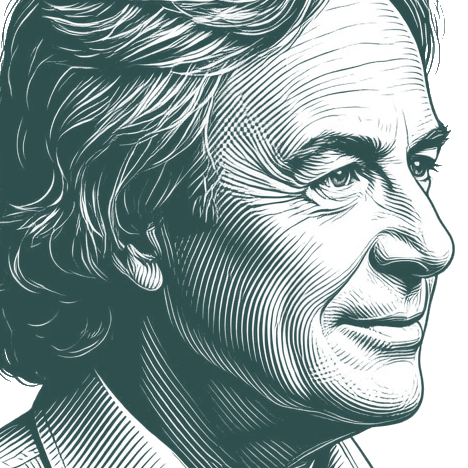
Portrait adapted from
Wikimedia Commons, Copyright Tamiko Thiel 1984 (CC BY-SA)
Also Known As
Pen Names:
Ofey
Native Name:
Richard Phillips Feynman
Alternative Names:
Feynman
•
Dick Feynman
•
Richard P. Feynman
We have written the equations of water flow. From experiment, we find a set of concepts and approximations to use to discuss the solution — vortex streets, turbulent wakes, boundary layers. When we have similar equations in a less familiar situation, and one for which we cannot yet experiment, we try to solve the equations in a primitive, halting, and confused way to try to determine what new qualitatitive features may come out, or what new qualitative forms are a consequence of the equations. Our equations for the sun, for example, as a ball of hydrogen gas, describe a sun without sunspots, without the rice-grain structure of the surface, without prominences, without coronas. Yet, all of these are really in the equations; we just haven't found the way to get them out.
...The test of science is its ability to predict. Had you never visited the earth, could you predict the thunderstorms, the volcanoes, the ocean waves, the auroras, and the colourful sunset? A salutary lesson it will be when we learn of all that goes on on each of those dead planets — those eight or ten balls, each agglomerated from the same dust clouds and each obeying exactly the same laws of physics.
The next great era of awakening of human intellect may well produce a method of understanding the qualitative content of equations. Today we cannot. Today we cannot see that the water flow equations contain such things as the barber pole structure of turbulence that one sees between rotating cylinders. Today we cannot see whether Schrodinger's equation contains frogs, musical composers, or morality — or whether it does not. We cannot say whether something beyond it like God is needed, or not. And so we can all hold strong opinions either way.