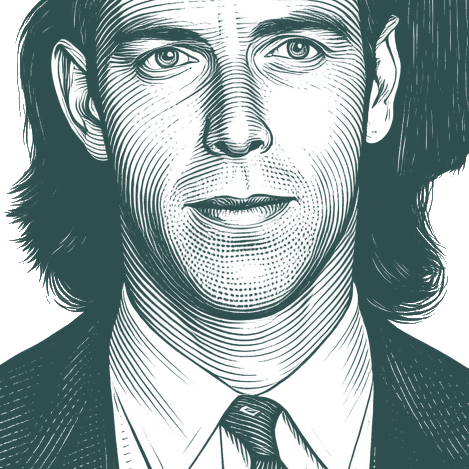
It's like you took a bottle of ink and you threw it at a wall. Smash! And all that ink spread. And in the middle, it's dense, isn't it? And as it get… - Alan Watts
""
It's like you took a bottle of ink and you threw it at a wall. Smash! And all that ink spread. And in the middle, it's dense, isn't it? And as it gets out on the edge, the little droplets get finer and finer and make more complicated patterns, see? So in the same way, there was a big bang at the beginning of things and it spread. And you and I, sitting here in this room, as complicated human beings, are way, way out on the fringe of that bang. We are the complicated little patterns on the end of it. Very interesting. But so we define ourselves as being only that. If you think that you are only inside your skin, you define yourself as one very complicated little curlique, way out on the edge of that explosion. Way out in space, and way out in time. Billions of years ago, you were a big bang, but now you're a complicated human being. And then we cut ourselves off, and don't feel that we're still the big bang. But you are. Depends how you define yourself. You are actually—if this is the way things started, if there was a big bang in the beginning—you're not something that's a result of the big bang. You're not something that is a sort of puppet on the end of the process. You are still the process. You are the big bang, the original force of the universe, coming on as whoever you are. When I meet you, I see not just what you define yourself as—Mr. so-and-so, Ms. so-and-so, Mrs. so-and-so—I see every one of you as the primordial energy of the universe coming on at me in this particular way. I know I'm that, too. But we've learned to define ourselves as separate from it.
English
Collect this quote
About
Alan Watts
Alan Wilson Watts (6 January 1915 – 16 November 1973) was an English philosopher, writer, speaker, and expert in comparative religion.
Biography information from
Wikiquote·
Portrait adapted from
Wikimedia Commons, The University of Vermont Alumni Magazine vol. 39 no. 01, p. 22. (Public domain / CC0)
Also Known As
Alternative Names:
Alan Wilson Watts
•
Alan W. Watts
"We therefore work, not for the work's sake, but for money — and money is supposed to get us what we really want in our hours of leisure and play. In the United States even poor people have lots of money compared with the wretched and skinny millions of India, Africa, and China, while our middle andupper classes (or should we say "income groups") are as prosperous as princes. Yet, by and large, they have but slight taste for pleasure. Money alone cannot buy pleasure, though it can help. For enjoyment is an art and a skill for which we have little talent or energy."
Timothy Leary was not so wide of the mark when he said that we must go out of our minds (abstract values) to come to our senses (concrete values). For coming to our senses must, above all, be the experience of our own existence as living organisms rather than “personalities,” like characters in a play or a novel acting out some artificial plot in which the persons are simply masks for a conflict of abstract ideas or principles. Man as an organism is to the world outside like a whirlpool is to a river: man and world are a single natural process, but we are behaving as if we were invaders and plunderers in a foreign territory. For when the individual is defined and felt as the separate personality or ego, he remains unaware that his actual body is a dancing pattern of energy that simply does not happen by itself. It happens only in concert with myriads of other patterns — called animals, plants, insects, bacteria, minerals, liquids, and gases. The definition of a person and the normal feeling of “I” do not effectively include these relationships. You say, “I came into this world.” You didn’t; you came out of it, as a branch from a tree.
PREMIUM FEATURE
Advanced Search Filters
Filter search results by source, date, and more with our premium search tools.
Our progress has been almost exclusively technological, which means that we are able to manipulate the physical world ever more sensationally, to increase the speed, the span, and the powers of material existence without any clear idea of what to do with the time gained and the powers acquired.