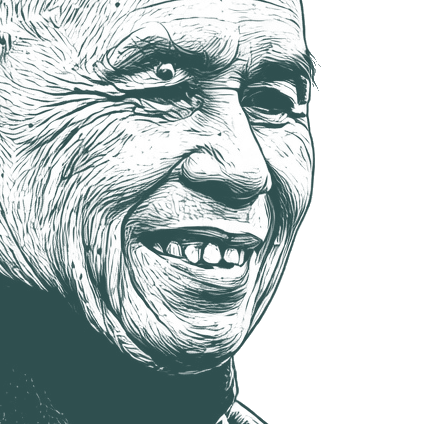
If you think while you walk, you’re not really walking. - Thích Nhất Hạnh
""
If you think while you walk, you’re not really walking.
English
Collect this quote
About
Thích Nhất Hạnh
Thích Nhất Hạnh (born as Nguyễn Xuân Bảo; 11 October 1926 – 22 January 2022) was an expatriate Vietnamese Buddhist monk, peace activist, and prolific author in both Vietnamese and English. Nhất Hạnh is most commonly referred to as Thích Nhất Hạnh, in which the Vietnamese title Thích (釋), derived from "Thích Ca" or "Thích Già" (釋迦) and applied to all Vietnamese Buddhist monks and nuns, means "of the Shakya (Shakyamuni Buddha) clan".
Biography information from
Wikiquote·
Portrait adapted from
Wikimedia Commons, Duc (pixiduc) from Paris, France. (CC BY-SA)
Also Known As
Alternative Names:
Nhat Hanh
•
Nguyễn Đình Lang
•
Nguyễn Xuân Bảo
•
Trừng Quang
•
Phùng Xuân
•
Thầy Nhất Hạnh
•
Thiền Sư Nhất Hạnh
•
Thich Nhat Hanh
According to the Buddha’s teachings, the most basic condition for happiness is freedom. Here we do not mean political freedom, but freedom from the mental formations of anger, despair, jealousy, and delusion. These mental formations are described by the Buddha as poisons. As long as these poisons are still in our heart, happiness cannot be possible.
To be beautiful means to be yourself. You don’t need to be accepted by others. You need to accept yourself.
Works in ChatGPT, Claude, or Any AI
Add semantic quote search to your AI assistant via MCP. One command setup.
Love needs to be nurtured and fed to survive; and our suffering also survives because we enable and feed it. We ruminate on suffering, regret, and sorrow. We chew on them, swallow them, bring them back up, and eat them again and again. If we’re feeding our suffering while we’re walking, working, eating, or talking, we are making ourselves victims of the ghosts of the past, of the future, or our worries in the present. We’re not living our lives.