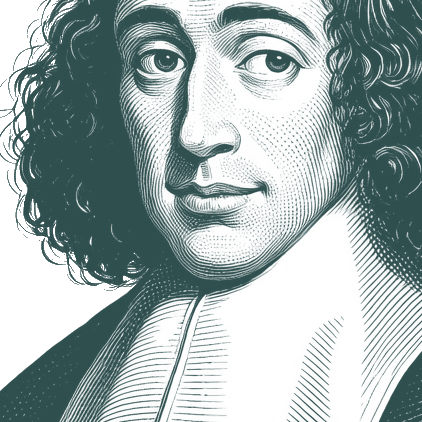
One explanation for Spinoza's status as unknown celebrity is the scandal he caused in his own time. As we shall see (in Chapter Six), his words were … - Benedictus de Spinoza
""
One explanation for Spinoza's status as unknown celebrity is the scandal he caused in his own time. As we shall see (in Chapter Six), his words were deemed heretical and banned for decades and with rare exceptions were quoted only as part of the assault on his work. The attacks paralyzed most attempts by Spinoza admirers to discuss his ideas publicly. The natural continuity of intellectual acknowledgment that follows a thinker's work was thus interrupted, even as some of his ideas were used uncredited. This state of affairs, however, hardly explains why Spinoza continued to gain fame but remained unknown once the likes of Goethe and Wordsworth began to champion him. Perhaps a better explanation is that Spinoza is not easy to know.
Benedictus de Spinoza (24 November 1632 – 21 February 1677) was a social and metaphysical philosopher known for the elaborate development of his monist philosophy, which has become known as Spinozism. Controversy regarding his ideas led to his excommunication from the Jewish community of his native Amsterdam. He was named Baruch ("blessed" in Hebrew) Spinoza by his synagogue elders and known as Bento de Spinoza or Bento d'Espiñoza, but afterwards used the name Benedictus ("blessed" in Latin) de Spinoza.
Native Name:
בָּרוּךְ שְׂפִּינוֹזָה
•
Benedito de Espinosa
Alternative Names:
Benedict de Spinoza
•
Baruch de Espinosa
•
Barukh Shpinozah
•
Benoît de Spinoza
•
Sbīnūzā
•
Ispīnūzā
•
Barukh Spinoza
•
Bento de Espinosa
•
Baruch d' Espinoza
•
Shpinozah
•
Baruch de Spinoza
•
Spinoza
•
Benoit de Spinoza
•
Benedictus De Spinoza
•
Benedictus Spinoza
•
Baruch Spinoza
•
Baruch Benedictus de Spinoza
I have laboured carefully, not to mock, lament, or execrate, but to understand human actions.
A comunidade amaldiçoa-me dia e noite, exortam a ira de Deus a recair sobre mim por toda a eternidade, pedem que todas as maldições contidas nas leis divinas me sejam infligidas, desejam que o meu nome desapareça para sempre do planeta, proíbem que quem quer que seja mantenha comigo qualquer tipo de relação, privada ou profissional, recusam compartilhar tecto comigo, e enfim proíbem que se aproximem a menos de quatro côvados de mim. Finalmente posso tornar-me um filósofo livre.
Works in ChatGPT, Claude, or Any AI
Add semantic quote search to your AI assistant via MCP. One command setup.