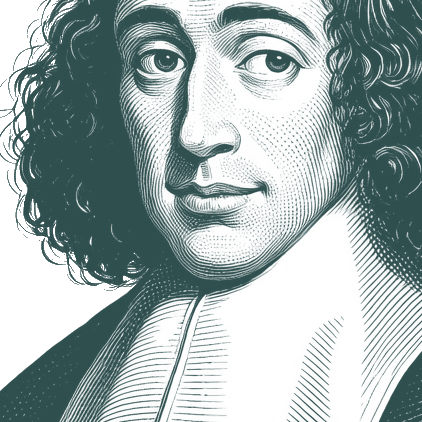
Affectus, quibus conflictamur, concipiunt philosophi veluti vitia, in quae homines sua culpa labuntur; quos propterea ridere, flere, carpere vel (qui… - Benedictus de Spinoza
""
Affectus, quibus conflictamur, concipiunt philosophi veluti vitia, in quae homines sua culpa labuntur; quos propterea ridere, flere, carpere vel (qui sanctiores videri volunt) detestari solent. Sic ergo se rem divinam facere, et sapientiae culmen attingere credunt, quando humanam naturam, quae nullibi est, multis modis laudare et eam, quae revera est, dictis lacessere norunt. Homines namque non ut sunt, sed ut eosdem esse vellent, concipiunt; unde factum est, ut plerumque pro e t h i c a satyram scripserint, et ut nunquam p o l i t i c a m conceperint, quae possit ad usum revocari; sed quae pro chimaera haberetur, vel quae in Utopia vel in illo poëtarum aureo saeculo, ubi scilicet minime necesse erat, institui potuisset. Cum igitur omnium scientiarum, quae usum habent, tum maxime p o l i t i c e s t h e o r i a ab ipsius p r a x i discrepare creditur, et regendae reipublicae nulli minus idonei aestimantur, quam theoretici seu philosophi.
Latin
Collect this quote
About
Benedictus de Spinoza
Benedictus de Spinoza (24 November 1632 – 21 February 1677) was a social and metaphysical philosopher known for the elaborate development of his monist philosophy, which has become known as Spinozism. Controversy regarding his ideas led to his excommunication from the Jewish community of his native Amsterdam. He was named Baruch ("blessed" in Hebrew) Spinoza by his synagogue elders and known as Bento de Spinoza or Bento d'Espiñoza, but afterwards used the name Benedictus ("blessed" in Latin) de Spinoza.
Native Name:
בָּרוּךְ שְׂפִּינוֹזָה
•
Benedito de Espinosa
Alternative Names:
Benedict de Spinoza
•
Baruch de Espinosa
•
Barukh Shpinozah
•
Benoît de Spinoza
•
Sbīnūzā
•
Ispīnūzā
•
Barukh Spinoza
•
Bento de Espinosa
•
Baruch d' Espinoza
•
Shpinozah
•
Baruch de Spinoza
•
Spinoza
•
Benoit de Spinoza
•
Benedictus De Spinoza
•
Benedictus Spinoza
•
Baruch Spinoza
•
Baruch Benedictus de Spinoza
The wish to preserve oneself is the symptom of a condition of distress, of a limitation of the really fundamental instinct of life which aims at the expansion of power and, wishing for that, frequently risks and even sacrifices self-preservation. It should be considered symptomatic when some philosophers–for example, Spinoza who was consumptive–considered the instinct of self-preservation decisive and had to see it that way; for they were individuals in conditions of distress.
Hegel is (unknowingly) an admirable 'theoretician' of ideology insofar as he is a 'theoretician' of Universal Recognition who unfortunately ends up in the ideology of Absolute Knowledge. Feuerbach is an astonishing 'theoretician' of the mirror connexion, who unfortunately ends up in the ideology of the Human Essence. To find the material with which to construct a theory of the guarantee, we must turn to Spinoza.
Unlimited Quote Collections
Organize your favorite quotes without limits. Create themed collections for every occasion with Premium.
Needs must it be hard, since it is so seldom found. How would it be possible, if salvation were ready to our hand, and could without great labour be found, that it should be by almost all men neglected? But all things excellent are as difficult as they are rare.