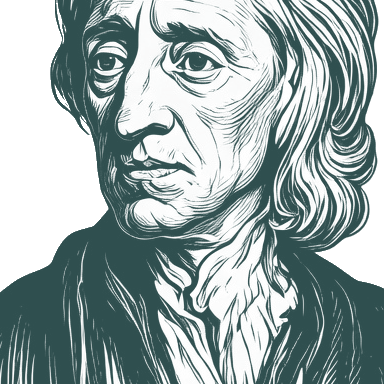
Inuring children gently to suffer some degrees of pain without shrinking, is a way to gain firmness to their minds, and lay a foundation for courage … - John Locke
""
Inuring children gently to suffer some degrees of pain without shrinking, is a way to gain firmness to their minds, and lay a foundation for courage and resolution in the future part of their lives.
John Locke (29 August 1632 – 28 October 1704) was an influential English philosopher and social contract theorist. He developed an alternative to the Hobbesian state of nature and asserted a government could be good only if it received the consent of the governed and protected the natural rights of life, liberty, and estate. If such a consent was not achieved, Locke argued in favour of a right of rebellion, which he referred to as an "appeal to heaven".
Biography information from
Wikiquote·
Portrait adapted from
Wikimedia Commons, Godfrey Kneller (Public domain / CC0)
[M]an's power, and its way of operation, [is] muchwhat the same in the material and intellectual world. For the materials in both being such as he has no power over, either to make or destroy, all that man can do, is either to unite them together, or to set them by one another, or wholly separate them.
and so made Jesus Christ nothing but the restorer and preacher of pure natural religion; thereby doing violence to the whole tenour of the New Testament.
Works in ChatGPT, Claude, or Any AI
Add semantic quote search to your AI assistant via MCP. One command setup.
El fin de la ley no es abolir o restringir, sino preservar y ampliar la libertad. Para todos los estados de seres creados, capaces de derecho, donde no hay ley, no hay libertad.