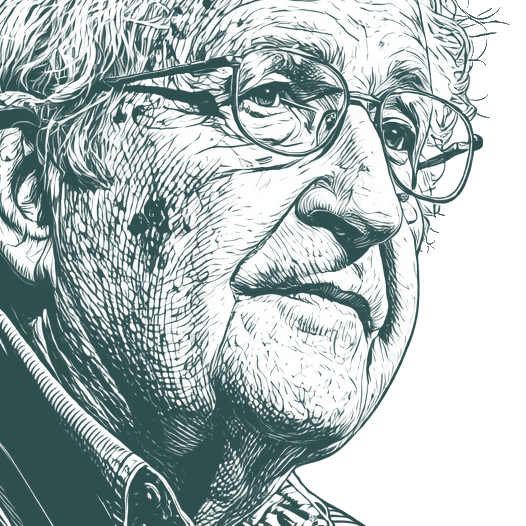
Because they don't teach the truth about the world, schools have to rely on beating students over the head with propaganda about democracy. If school… - Noam Chomsky
""
Because they don't teach the truth about the world, schools have to rely on beating students over the head with propaganda about democracy. If schools were, in reality, democratic, there would be no need to bombard students with platitudes about democracy. They would simply act and behave democratically, and we know this does not happen. The more there is a need to talk about the ideals of democracy, the less democratic the system usually is.
Avram Noam Chomsky (born 7 December 1928) is an American linguist, analytical philosopher, cognitive scientist, political analyst, human rights activist and anarcho-socialist.
Biography information from
Wikiquote·
Portrait adapted from
Wikimedia Commons, Augusto Starita / Ministerio de Cultura de la Nación (CC BY-SA)
Every year thousands of people, mostly children and poor farmers, are killed in the Plain of Jars in Northern Laos, the scene of the heaviest bombing of civilian targets in history it appears, and arguably the most cruel: Washington's furious assault on a poor peasant society had little to do with its wars in the region. The worst period was from 1968, when Washington was compelled to undertake negotiations (under popular and business pressure), ending the regular bombardment of North Vietnam. Kissinger-Nixon then decided to shift the planes to bombardment of Laos and Cambodia. The deaths are from "bombies," tiny anti-personnel weapons, far worse than land-mines: they are designed specifically to kill and maim, and have no effect on trucks, buildings, etc. The Plain was saturated with hundreds of millions of these criminal devices, which have a failure-to-explode rate of 20%-30% according to the manufacturer, Honeywell. The numbers suggest either remarkably poor quality control or a rational policy of murdering civilians by delayed action. These were only a fraction of the technology deployed, including advanced missiles to penetrate caves where families sought shelter. Current annual casualties from "bombies" are estimated from hundreds a year to "an annual nationwide casualty rate of 20,000," more than half of them deaths, according to the veteran Asia reporter Barry Wain of the Wall Street Journal -- in its Asia edition. A conservative estimate, then, is that the crisis this year is approximately comparable to Kosovo, though deaths are far more highly concentrated among children -- over half, according to analyses reported by the Mennonite Central Committee, which has been working there since 1977 to alleviate the continuing atrocities. There have been efforts to publicize and deal with the humanitarian catastrophe. A British-based Mine Advisory Group (MAG) is trying to remove the lethal objects, but the US is "conspicuously missing from the handful of Western organizations that have followed MAG," the British press reports, though it has finally agreed to train some Laotian civilians. The British press also reports, with some anger, the allegation of MAG specialists that the US refuses to provide them with "render harmless procedures" that would make their work "a lot quicker and a lot safer." These remain a state secret, as does the whole affair in the United States. The Bangkok press reports a very similar situation in Cambodia, particularly the Eastern region where US bombardment from early 1969 was most intense.
I'm of course opposed to terror, any rational person is, but I think that if we're serious about the question of terror and serious about the question of violence we have to recognize that it is a tactical and hence moral matter. Incidentally, tactical issues are basically moral issues. They have to do with human consequences. And if we're interested in, let's say, diminishing the amount of violence in the world, it's at least arguable and sometimes true that a terroristic act does diminish the amount of violence in the world. Hence a person who is opposed to violence will not be opposed to that terroristic act.
The general question of nuclear power is not a simple one. It is hardly necessary to stress how dangerous it is after the Fukushima nuclear disaster, which has far from ended. Continued use of fossil fuels threatens global disaster, and not in the distant future. The sensible course would be to move as quickly as possible to sustainable energy sources, as Germany is now doing. The alternatives are too disastrous to contemplate.