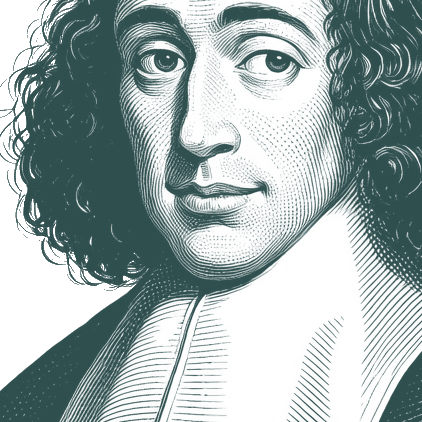
Spinoza believed that he had, through metaphysical inquiry, discovered important truths about God, nature and human beings, truths that led to princi… - Benedictus de Spinoza
""
Spinoza believed that he had, through metaphysical inquiry, discovered important truths about God, nature and human beings, truths that led to principles of great consequence for our happiness and our emotional and physical flourishing. This, in fact, is what he called “true religion.” There is a lesson here: By enforcing conformity of belief and punishing deviations from dogma, religious authorities may end up depriving the devoted of the possibility of achieving in religion that which they most urgently seek.
English
Collect this quote
About
Benedictus de Spinoza
Benedictus de Spinoza (24 November 1632 – 21 February 1677) was a social and metaphysical philosopher known for the elaborate development of his monist philosophy, which has become known as Spinozism. Controversy regarding his ideas led to his excommunication from the Jewish community of his native Amsterdam. He was named Baruch ("blessed" in Hebrew) Spinoza by his synagogue elders and known as Bento de Spinoza or Bento d'Espiñoza, but afterwards used the name Benedictus ("blessed" in Latin) de Spinoza.
Native Name:
בָּרוּךְ שְׂפִּינוֹזָה
•
Benedito de Espinosa
Alternative Names:
Benedict de Spinoza
•
Baruch de Espinosa
•
Barukh Shpinozah
•
Benoît de Spinoza
•
Sbīnūzā
•
Ispīnūzā
•
Barukh Spinoza
•
Bento de Espinosa
•
Baruch d' Espinoza
•
Shpinozah
•
Baruch de Spinoza
•
Spinoza
•
Benoit de Spinoza
•
Benedictus De Spinoza
•
Benedictus Spinoza
•
Baruch Spinoza
•
Baruch Benedictus de Spinoza
The ordinary surroundings of life which are esteemed by men (as their actions testify) to be the highest good, may be classed under the three heads — Riches, Fame, and the Pleasures of Sense: with these three the mind is so absorbed that it has little power to reflect on any different good.
To express myself briefly, Goethe was the Spinoza of poetry. The whole of Goethe's poetry is filled with the same spirit that is wafted toward us from the writings of Spinoza. There is no doubt whatsoever that Goethe paid undivided allegiance to Spinoza's doctrine. At any rate, he occupied himself with it throughout his entire life; in the first part of his memoirs as well as in the last volume, recently published, he frankly acknowledged this. I don't remember now where I read that Herder once exploded peevishly at the constant preoccupation with Spinoza, "If Goethe would only for once pick up some other Latin book than Spinoza!" But this applies not only to Goethe; quite a number of his friends, who later became more or less well-known as poets, paid homage to pantheism in their youth, and this doctrine flourished actively in German art before it attained supremacy among us as a philosophic theory.
Limited Time Offer
Premium members can get their quote collection automatically imported into their Quotewise collections.
Spinoza's naturalist and rationalist project demands that we provide these notions with a proper intellectualist interpretation. Thus, the love of God is simply an awareness of the ultimate natural cause of the joy that accompanies the improvement in one's condition that the highest knowledge brings; to love God is nothing but to understand nature. And the eternity in which one participates is represented solely by the knowledge of eternal truths that makes up a part of the rational person's mind.