(i) Never use a metaphor, simile, or other figure of speech which you are used to seeing in print.
(ii) Never use a long word where a short one will … - George Orwell
""
(i) Never use a metaphor, simile, or other figure of speech which you are used to seeing in print. (ii) Never use a long word where a short one will do. (iii) If it is possible to cut a word out, always cut it out. (iv) Never use the passive where you can use the active. (v) Never use a foreign phrase, a scientific word, or a jargon word if you can think of an everyday English equivalent. (vi) Break any of these rules sooner than say anything outright barbarous.
English
Collect this quote
About
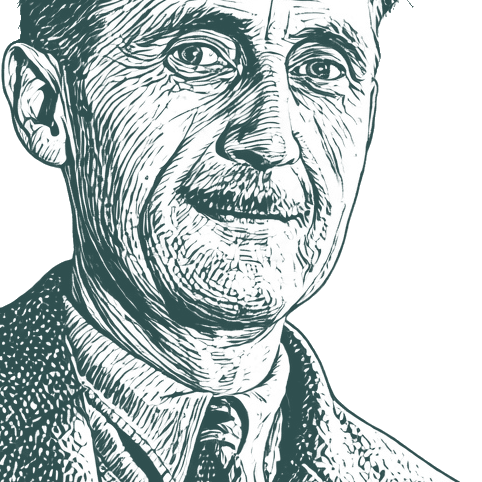
George Orwell
George Orwell (25 June 1903 – 21 January 1950) was the pen name of British novelist, essayist, and journalist Eric Arthur Blair, whose work is characterised by lucid prose, awareness of social injustice, opposition to totalitarianism, and strong support of democratic socialism.
Biography information from
Wikiquote·
Portrait adapted from
Wikimedia Commons, Cassowary Colorizations (CC BY)
Also Known As
Pen Names:
John Freeman
Birth Name:
Eric Arthur Blair
Alternative Names:
Orwell
•
Eric Blair
•
P. S. Burton
The Communists had gained power and a vast increase of membership partly by appealing to the middle classes against the revolutionaries, but partly also because they were the only people who looked capable of winning the war. -- Chap. 5
ففي زمن من الأزمان كان من الجنون أن تعتقد أن الأرض تدور حول الشمس ،أما اليوم فالجنون هو أن تعتقد أن الماضي غير قابل للتبديل.
Unlimited Quote Collections
Organize your favorite quotes without limits. Create themed collections for every occasion with Premium.
While the game of deadlocks and bottle-necks goes on, another more serious game is also being played. It is governed by two axioms. One is that there can be no peace without a general surrender of sovereignty: the other is that no country capable of defending its sovereignty ever surrenders it. If one keeps these axioms in mind one can generally see the relevant facts in international affairs through the smoke-screen with which the newspapers surround them.