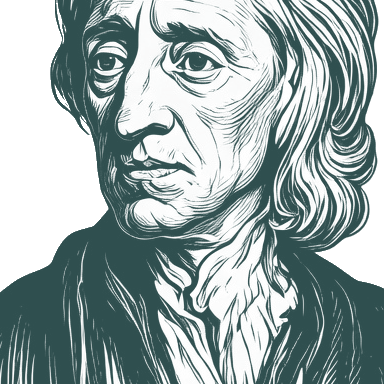
Adam's children, being not presently as soon as born under this law of reason, were not presently free : for law, in its true notion, is not so much … - John Locke
""
Adam's children, being not presently as soon as born under this law of reason, were not presently free : for law, in its true notion, is not so much the limitation, as the direction of a free and intelligent agent to his proper interest, and prescribes no farther than is for the general good of those under that law:
English
Collect this quote
About
John Locke
John Locke (29 August 1632 – 28 October 1704) was an influential English philosopher and social contract theorist. He developed an alternative to the Hobbesian state of nature and asserted a government could be good only if it received the consent of the governed and protected the natural rights of life, liberty, and estate. If such a consent was not achieved, Locke argued in favour of a right of rebellion, which he referred to as an "appeal to heaven".
Biography information from
Wikiquote·
Portrait adapted from
Wikimedia Commons, Godfrey Kneller (Public domain / CC0)
Covetousness, and the desire of having in our possession, and under our dominion, more than we have need of, being the root of all evil, should be early and carefully weeded out, and the contrary quality of a readiness to impart to others, implanted. This should be encourag'd by great commendation and credit, and constantly taking care that he loses nothing by his liberality.
I pretend not to teach, but to inquire; and therefore cannot but confess here again,–that external and internal sensation are the only passages I can find of knowledge to the understanding. These alone, as far as I can discover, are the windows by which light is let into this DARK ROOM. For, methinks, the understanding is not much unlike a closet wholly shut from light, with only some little openings left, to let in external visible resemblances, or ideas of things without: which, would they but stay there, and lie so orderly as to be found upon occasion, it would very much resemble the understanding of a man, in reference to all objects of sight, and the ideas of them.
PREMIUM FEATURE
Advanced Search Filters
Filter search results by source, date, and more with our premium search tools.