"What is in mind is a sort of Chautauqua...that's the only name I can think of for it...like the traveling tent-show Chautauquas that used to move ac… - Robert M. Pirsig
"What is in mind is a sort of Chautauqua...that's the only name I can think of for it...like the traveling tent-show Chautauquas that used to move across America, this America, the one that we are now in, an old-time series of popular talks intended to edify and entertain, improve the mind and bring culture and enlightenment to the ears and thoughts of the hearer. The Chautauquas were pushed aside by faster-paced radio, movies and TV, and it seems to me the change was not entirely an improvement. Perhaps because of these changes the stream of national consciousness moves faster now, and is broader, but it seems to run less deep. The old channels cannot contain it and in its search for new ones there seems to be growing havoc and destruction along its banks. In this Chautauqua I would like not to cut any new channels of consciousness but simply dig deeper into old ones that have become silted in with the debris of thoughts grown stale and platitudes too often repeated. "What's new?" is an interesting and broadening eternal question, but one which, if pursued exclusively, results only in an endless parade of trivia and fashion, the silt of tomorrow. I would like, instead, to be concerned with the question "What is best?," a question which cuts deeply rather than broadly, a question whose answers tend to move the silt downstream. There are eras of human history in which the channels of thought have been too deeply cut and no change was possible, and nothing new ever happened, and "best" was a matter of dogma, but that is not the situation now. Now the stream of our common consciousness seems to be obliterating its own banks, losing its central direction and purpose, flooding the lowlands, disconnecting and isolating the highlands and to no particular purpose other than the wasteful fulfillment of its own internal momentum. Some channel deepening seems called for."
Robert Maynard Pirsig (6 September 1928 – 24 April 2017) was an American philosopher and novelist, most famous for his novel Zen and the Art of Motorcycle Maintenance in which he proposed what has become known as his Metaphysics of Quality (MoQ).
Biography information from
Wikiquote·
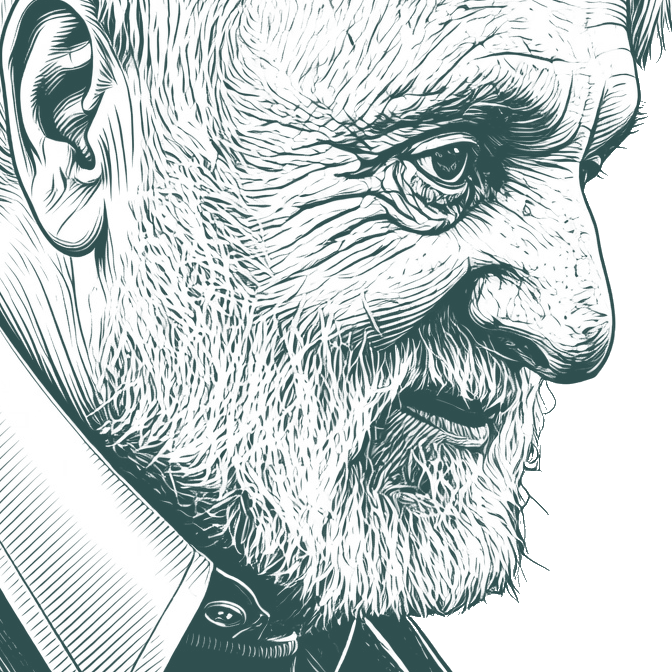
Portrait adapted from
Wikimedia Commons, Ian Glendinning, en:User:IanGlendinning (CC BY)
Also Known As
Alternative Names:
Robert Maynard Pirsig
•
Robert Pirsig
If you eliminate suffering from this world you eliminate life. There's no evolution. Those species that don't suffer don't survive. Sometimes the insane and the contrarians and the ones who are the closest to suicide are the most valuable people society has. They may be the precursors of social change. They've taken the burdens of the culture onto themselves and in their struggle to solve their own problems they're solving problems for the culture as well
In my mind, when I look at these fields, I say to her, “See?…See?” and I think she does. I hope later she will see and feel a thing about these prairies I have given up talking to others about; a thing that exists here because everything else does not and can be noticed because other things are absent. She seems so depressed sometimes by the monotony and boredom of her city life, I thought maybe in this endless grass and wind she would see a thing that sometimes comes when monotony and boredom are accepted. It’s here, but I have no names for it.
Go Premium
Support Quotewise while enjoying an ad-free experience and premium features.
My personal feeling is that this is how any further improvement of the world will be done: by individuals making Quality decisions and that's all. God, I don't want to have any more enthusiasm for big programs full of social planning for big masses of people that leave individual Quality out. These can be left alone for a while. There's a place for them but they've got to be built on a foundation of Quality within the individuals involved. We've had that individual Quality in the past, exploited it as a natural resource without knowing it, and now it's just about depleted. Everyone's just about out of gumption. And I think it's about time to return to the rebuilding of this American resource—individual worth. There are political reactionaries who've been saying something close to this for years. I'm not one of them, but to the extent they're talking about real individual worth and not just an excuse for giving more money to the rich, they're right. We do need a return to individual integrity, self-reliance and old-fashioned gumption. We really do.