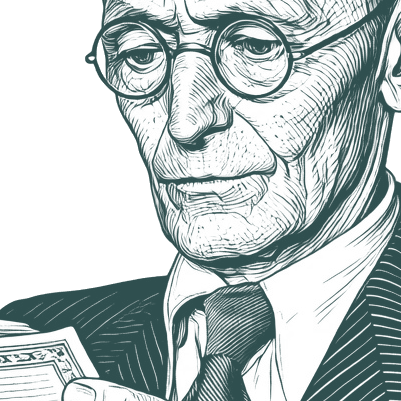
"You love nobody. Is that not true?"
"Maybe," said Siddhartha wearily. "I am like you. You cannot love either, otherwise how could you practice love … - Hermann Hesse
"You love nobody. Is that not true?" "Maybe," said Siddhartha wearily. "I am like you. You cannot love either, otherwise how could you practice love as an art? Perhaps people like us cannot love. Ordinary people can - that is their secret."
English
Collect this quote
About
Hermann Hesse
Hermann Karl Hesse (2 July 1877 – 9 August 1962) was a German-Swiss poet, novelist, and painter. In 1946, he received the Nobel Prize in Literature. His most famous works include Steppenwolf, Siddhartha, and The Glass Bead Game (also known as Magister Ludi) all of which explore an individual's search for spirituality.
Now what we call “bourgeois,” when regarded as an element always to be found in human life, is nothing else than the search for a balance. It is the striving after a mean between the countless extremes and opposite that arise in human conduct.
The diabolical thing about melancholy is not that it makes you ill but that it makes you conceited and shortsighted; yes almost arrogant. You lapse into bad taste, thinking of yourself as Heine's Atlas, whose shoulders support all the world's puzzles and agonies, as if thousands, lost in the same maze, did not endure the same agonies.
PREMIUM FEATURE
Advanced Search Filters
Filter search results by source, date, and more with our premium search tools.