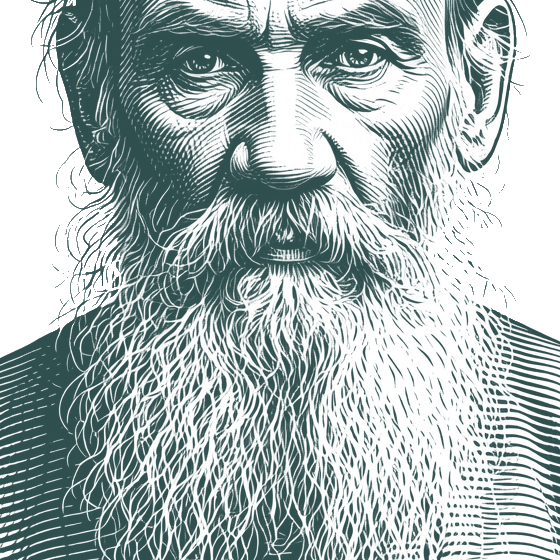
Lev Nikolayevitch Tolstoy [Ле́в Никола́евич Толсто́й, usually rendered Leo Tolstoy, or sometimes Tolstoi] (9 September 1828 – 20 November 1910) was a Russian writer, philosopher and social activist (social critic), whose novels War and Peace and Anna Karenina are internationally praised classics of world literature. He was a major influence on the development of Christian anarchism and pacifism, contributing to such nonviolent resistance movements as those of Mahatma Gandhi, Martin Luther King, Jr., and James Bevel.
Biography information from
Wikiquote·
Portrait adapted from
Wikimedia Commons, Sergei Prokudin-Gorskii (Public domain / CC0)
Also Known As
Pen Names:
Л. Н. Т.
•
Л. Н.
Birth Name:
Lev Nikolayevich Tolstoy
Native Name:
Лев Никола́евич Толсто́й
Alternative Names:
Count Lev Nikolayevich Tolstoy
•
Tolstoy, Leo, graf, 1828-1910
•
Tolstoĭ, Lev Nikolaevich, graf, 1828-1910
•
Lev Nikolayevich Tolstoĭ
•
Leo Tolstoi
•
Tolstoĭ, Lev Nikolaevich, graf
•
Tolstoy, Leo, graf
لو أن عصفوراً هجر الطيران و شغف بركوب الدراجة ، جاء إلى يشكو مما ينتابه بين الحين و الحين من اضطرابات عصبية ، و يطلب منى أن أصف له الدواء ، لما لبيت طلبه ، و لأمرته فى غضب أن يعود إلى ما خلق من أجله
The recognition that love represents the highest morality was nowhere denied or contradicted, but this truth was so interwoven everywhere with all kinds of falsehoods which distorted it, that finally nothing of it remained but words. It was taught that this highest morality was only applicable to private life — for home use, as it were — but that in public life all forms of violence — such as imprisonment, executions, and wars — might be used for the protection of the majority against a minority of evildoers, though such means were diametrically opposed to any vestige of love.
Works in ChatGPT, Claude, or Any AI
Add semantic quote search to your AI assistant via MCP. One command setup.
When I started life Hegelianism was the basis of everything: it was in the air, found expression in magazine and newspaper articles, in novels and essays, in art, in histories, in sermons, and in conversation. A man unacquainted with Hegel had no right to speak: he who wished to know the truth studied Hegel. Everything rested on him; and suddenly forty years have gone by and there is nothing left of him, he is not even mentioned — as though he had never existed. And what is most remarkable is that, like pseudo-Christianity, Hegelianism fell not because anyone refuted it, but because it suddenly became evident that neither the one nor the other was needed by our learned, educated world.