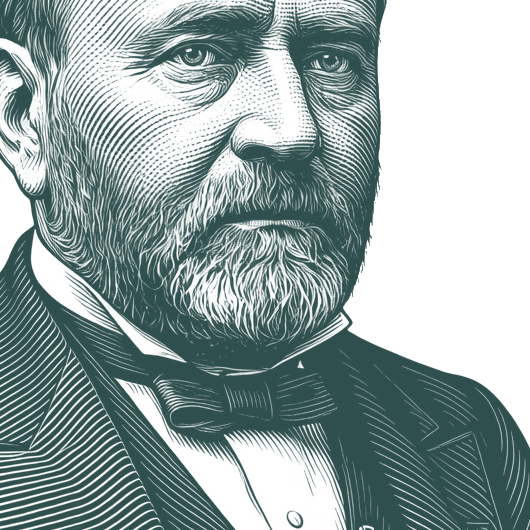
Leave the matter of religion to the family altar the church and the private school supported entirely by private contributions. Keep the church and s… - Ulysses S. Grant
""
Leave the matter of religion to the family altar the church and the private school supported entirely by private contributions. Keep the church and state forever separate.
Ulysses S. Grant (27 April 1822 – 23 July 1885), born as Hiram Ulysses Grant, was the 18th president of the United States of America, from 1869 to 1877. As the Commanding General of the U.S. Army, Grant worked closely with U.S. President Abraham Lincoln to lead the U.S. Army to victory over the Confederacy in the American Civil War. He implemented Congressional Reconstruction, often at odds with Lincoln's successor, Andrew Johnson. Twice elected to the presidency, Grant led the Republicans in their effort to remove the vestiges of Confederate nationalism and slavery, protect the citizenship of African-Americans, and support U.S. economic prosperity.
Biography information from
Wikiquote·
Portrait adapted from
Wikimedia Commons, Brady-Handy Photograph Collection, Library of Congress (Public domain / CC0)
Also Known As
Birth Name:
Hiram Ulysses Grant
Also Known As:“Unconditional Surrender” Grant
Alternative Names:
General Grant
•
Ulysses Hiram Grant
•
Ulysses Grant
•
Ulysses S Grant
•
President Grant
•
U. S. Grant
•
U.S. Grant
•
Ulysses Simpson Grant
Portrait from Wikimedia Commons. Credit: Brady-Handy Photograph Collection, Library of Congress. Used under Public domain / CC0. Processed and styled by Quotewise.
Works in ChatGPT, Claude, or Any AI
Add semantic quote search to your AI assistant via MCP. One command setup.
There are many men who would have done better than I did under the circumstances in which I found myself. If I had never held command, if I had fallen, there were 10,000 behind who would have followed the contest to the end and never surrendered the Union.
Enjoined by the Constitution 'to take care that the laws be faithfully executed', and convinced by undoubted evidence that violations of said act had been committed and that a widespread and flagrant disregard of it was contemplated, the proper officers were instructed to prosecute the offenders, and troops were stationed at convenient points to aid these officers, if necessary, in the performance of their official duties. Complaints are made of this interference by Federal authority; but if said amendment and act do not provide for such interference under the circumstances as above stated, then they are without meaning, force, or effect, and the whole scheme of colored enfranchisement is worse than mockery and little better than a crime. Possibly Congress may find it due to truth and justice to ascertain, by means of a committee, whether the alleged wrongs to colored citizens for political purposes are real or the reports thereof were manufactured for the occasion.
I refer to these circumstances with minuteness because I did General McCook injustice in my article in the Century, though not to the extent one would suppose from the public press. I am not willing to do any one an injustice, and if convinced that I have done one, I am always willing to make the fullest admission.]