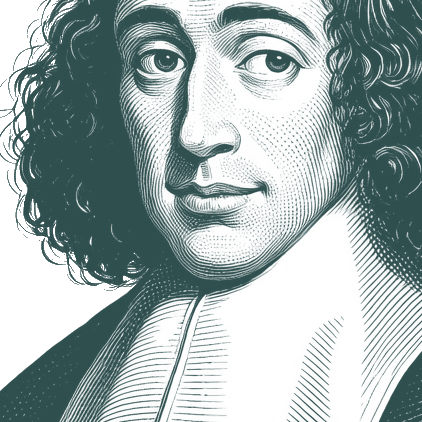
The body itself, simply from the laws of its own nature, can do many things which its mind wonders at … it is in the mind’s power alone both to speak… - Benedictus de Spinoza
""
The body itself, simply from the laws of its own nature, can do many things which its mind wonders at … it is in the mind’s power alone both to speak and to be silent and to do many other things which they therefore believe depend on the mind’s decision … if, on the other hand, the body is inactive, the mind is at the same time incapable of thinking
Benedictus de Spinoza (24 November 1632 – 21 February 1677) was a social and metaphysical philosopher known for the elaborate development of his monist philosophy, which has become known as Spinozism. Controversy regarding his ideas led to his excommunication from the Jewish community of his native Amsterdam. He was named Baruch ("blessed" in Hebrew) Spinoza by his synagogue elders and known as Bento de Spinoza or Bento d'Espiñoza, but afterwards used the name Benedictus ("blessed" in Latin) de Spinoza.
Native Name:
בָּרוּךְ שְׂפִּינוֹזָה
•
Benedito de Espinosa
Alternative Names:
Benedict de Spinoza
•
Baruch de Espinosa
•
Barukh Shpinozah
•
Benoît de Spinoza
•
Sbīnūzā
•
Ispīnūzā
•
Barukh Spinoza
•
Bento de Espinosa
•
Baruch d' Espinoza
•
Shpinozah
•
Baruch de Spinoza
•
Spinoza
•
Benoit de Spinoza
•
Benedictus De Spinoza
•
Benedictus Spinoza
•
Baruch Spinoza
•
Baruch Benedictus de Spinoza
Schelling calls Spinoza "the first philosopher who found the concepts whereby all the following centuries have grasped and fixed the two extremities of our knowing mind." For Lessing and Herder philosophy and Spinozism were identical; and the same statement was also made by Hegel, the most comprehensive and systematic, as well as the most independent and firm, among the German philosophers, who did not attempt, like Leibnitz, Fichte or Schelling, to reshape again and again his original-philosophy. And Hegel also said, "either you have Spinozism or you have no philosophy!"
I love our old Chuang-tzu because I love his pantheism, because he got a living by making straw shoes. I love the Dutchman Spinoza because I love his pantheism, because he got a living by grinding lenses. I love the Indian Kabir because I love his pantheism, because he got a living by knotting fishing-nets.
Works in ChatGPT, Claude, or Any AI
Add semantic quote search to your AI assistant via MCP. One command setup.
Your question is the most difficult in the world. It is not a question I can answer simply with yes or no. I am not an Atheist. I do not know if I can define myself as a Pantheist. The problem involved is too vast for our limited minds. May I not reply with a parable? The human mind, no matter how highly trained, cannot grasp the universe. We are in the position of a little child, entering a huge library whose walls are covered to the ceiling with books in many different tongues. The child knows that someone must have written those books. It does not know who or how. It does not understand the languages in which they are written. The child notes a definite plan in the arrangement of the books, a mysterious order, which it does not comprehend, but only dimly suspects. That, it seems to me, is the attitude of the human mind, even the greatest and most cultured, toward God. We see a universe marvelously arranged, obeying certain laws, but we understand the laws only dimly. Our limited minds cannot grasp the mysterious force that sways the constellations. I am fascinated by Spinoza's Pantheism. I admire even more his contributions to modern thought. Spinoza is the greatest of modern philosophers, because he is the first philosopher who deals with the soul and the body as one, not as two separate things.