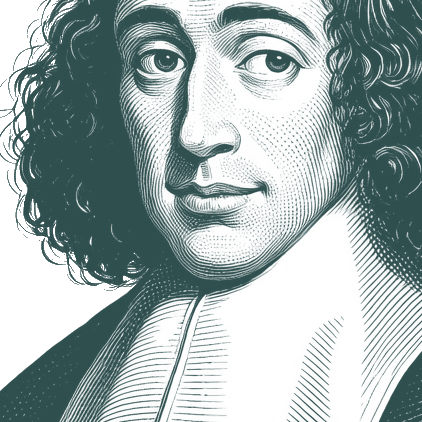
Do you remember Goethe's wise words about reading Spinoza? — “I always preferred knowing what an author himself said, to knowing what others thought … - Benedictus de Spinoza
""
Do you remember Goethe's wise words about reading Spinoza? — “I always preferred knowing what an author himself said, to knowing what others thought he ought to have said.”
Benedictus de Spinoza (24 November 1632 – 21 February 1677) was a social and metaphysical philosopher known for the elaborate development of his monist philosophy, which has become known as Spinozism. Controversy regarding his ideas led to his excommunication from the Jewish community of his native Amsterdam. He was named Baruch ("blessed" in Hebrew) Spinoza by his synagogue elders and known as Bento de Spinoza or Bento d'Espiñoza, but afterwards used the name Benedictus ("blessed" in Latin) de Spinoza.
Native Name:
בָּרוּךְ שְׂפִּינוֹזָה
•
Benedito de Espinosa
Alternative Names:
Benedict de Spinoza
•
Baruch de Espinosa
•
Barukh Shpinozah
•
Benoît de Spinoza
•
Sbīnūzā
•
Ispīnūzā
•
Barukh Spinoza
•
Bento de Espinosa
•
Baruch d' Espinoza
•
Shpinozah
•
Baruch de Spinoza
•
Spinoza
•
Benoit de Spinoza
•
Benedictus De Spinoza
•
Benedictus Spinoza
•
Baruch Spinoza
•
Baruch Benedictus de Spinoza
I have thus completed all I wished to set forth touching the mind's power over the emotions and the mind's freedom. Whence it appears how potent is the wise man and how much he surpasses the ignorant man who is driven only by his lusts. For the ignorant man is not only distracted in various ways by external causes without ever gaining the true acquiescence of his spirit, but more over lives, as it were, unwitting of himself, and of God, and of things, and as soon as he ceases to suffer, ceases also to be: Whereas the wise man, in as far as he is regarded as such, is scarcely at all disturbed in spirit, but, being conscious of himself, and of God, and of things, by a certain eternal necessity, never ceases to be, but always possesses true acquiescence of his spirit. If the way which I have pointed out as leading to this result, seems exceedingly hard, it may nevertheless be discovered. Needs must it be hard, since it is so seldom found. How would it be possible, if salvation were ready to our hand, and could without great labour be found, that it should be by almost all men neglected? But all things excellent are as di_fcult as they are rare.
Love is nothing but Joy with the accompanying idea of an external cause (Ethics, part III, proposition 13, scholium).
Limited Time Offer
Premium members can get their quote collection automatically imported into their Quotewise collections.
...Lately I have been re-reading Spinoza (much read and little understood in my youth). But that noblest of Jews must have planted no end of germs in my brains, for I see that what I have to say is in principle what he had to say, in modern language.