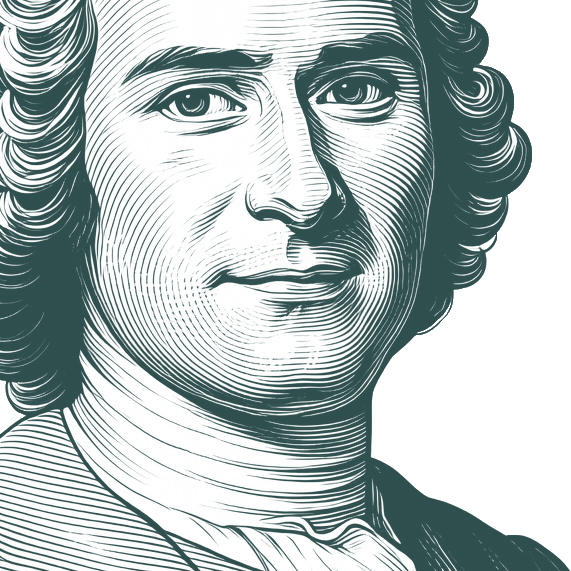
Hay más: el verdadero placer no se describe; sólo se siente, y tanto más cuanto menos puede describirse, porque no resulta de un conjunto de hechos s… - Jean-Jacques Rousseau
""
Hay más: el verdadero placer no se describe; sólo se siente, y tanto más cuanto menos puede describirse, porque no resulta de un conjunto de hechos sino de un estado permanente.
Jean-Jacques Rousseau (June 28, 1712 – July 2, 1778) was a major French-speaking Genevan philosopher of Enlightenment whose political ideas influenced the French Revolution, the development of socialist theory, and the growth of nationalism.
Biography information from
Wikiquote·
Portrait adapted from
Wikimedia Commons, Maurice Quentin de La Tour (Public domain / CC0)
Also Known As
Alternative Names:
Citizen of Geneva
•
Jean Jacques Rousseau
•
J. J. Rousseau
•
Rousseau
•
J.J. Rousseau
•
JJ Rousseau
Objektif bakımdan, ezilenlerin teselli olarak bir Tanrı'ya inanmaları, halk yığınlarını mücadeleden uzaklaştırmaktan başka bir sonuç vermez.
I am beginning to feel the drunkenness that this agitated, tumultuous life plunges you into. With such a multitude of objects passing before my eyes, I’m getting dizzy. Of all the things that strike me, there is none that holds my heart, yet all of them together disturb my feelings, so that I forget what I am and who I belong to.
Unlimited Quote Collections
Organize your favorite quotes without limits. Create themed collections for every occasion with Premium.
others, without further ceremony ascribing to the strongest an authority over the weakest, have immediately struck out government, without thinking of the time requisite for men to form any notion of the things signified by the words authority and government. All of them, in fine, constantly harping on wants, avidity, oppression, desires and pride, have transferred to the state of nature ideas picked up in the bosom of society. In speaking of savages they described citizens. Nay, few of our own writers seem to have so much as doubted, that a state of nature did once actually exit; though it plainly appears by Sacred History, that even the first man, immediately furnished as he was by God himself with both instructions and precepts, never lived in that state, and that, if we give to the books of Moses that credit which every Christian philosopher ought to give to them, we must deny that, even before the deluge, such a state ever existed among men, unless they fell into it by some extraordinary event: a paradox very difficult to maintain, and altogether impossible to prove.