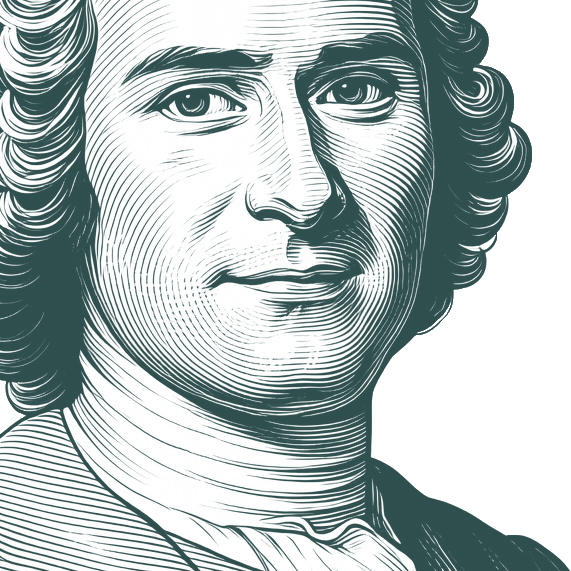
Force is a physical power; I do not see how its effects could produce morality. To yield to force is an act of necessity, not of will; it is at best … - Jean-Jacques Rousseau
""
Force is a physical power; I do not see how its effects could produce morality. To yield to force is an act of necessity, not of will; it is at best an act of prudence. In what sense can it be a moral duty?
Jean-Jacques Rousseau (June 28, 1712 – July 2, 1778) was a major French-speaking Genevan philosopher of Enlightenment whose political ideas influenced the French Revolution, the development of socialist theory, and the growth of nationalism.
Biography information from
Wikiquote·
Portrait adapted from
Wikimedia Commons, Maurice Quentin de La Tour (Public domain / CC0)
Also Known As
Alternative Names:
Citizen of Geneva
•
Jean Jacques Rousseau
•
J. J. Rousseau
•
Rousseau
•
J.J. Rousseau
•
JJ Rousseau
One always wants what is good for oneself, but one does not always see it. The people is never corrupted, but it is often fooled, and only then does it appear to want what is bad.
Everything is good as it leaves the hands of the Author of things; everything degenerates in the hands of man. He forces one soil to nourish the products of another, one tree to bear the fruit of another. He mixes and confuses the climates, the elements, the seasons. He mutilates his dog, his horse, his slave. He turns everything upside down; he disfigures everything; he loves deformity, monsters. He wants nothing as nature made it, not even man; for him, man must be trained like a school horse; man must be fashioned in keeping with his fancy like a tree in his garden
Works in ChatGPT, Claude, or Any AI
Add semantic quote search to your AI assistant via MCP. One command setup.