We are so used to looking at the world from the point of view of living things that we cannot understand what it means not to be alive, and yet most … - Richard Feynman
""
We are so used to looking at the world from the point of view of living things that we cannot understand what it means not to be alive, and yet most of the time the world had nothing alive on it. And in most places in the universe today there probably is nothing alive.
English
Collect this quote
About
Richard Feynman
Richard Phillips Feynman (May 11, 1918 – February 15, 1988) was an American theoretical physicist. He is known for the work he did in the path integral formulation of quantum mechanics, the theory of quantum electrodynamics, the physics of the superfluidity of supercooled liquid helium, and in particle physics, for which he proposed the parton model. For his contributions to the development of quantum electrodynamics, Feynman received the Nobel Prize in Physics in 1965 jointly with Julian Schwinger and Shin'ichirō Tomonaga. Feynman developed a widely used pictorial representation scheme for the mathematical expressions describing the behavior of subatomic particles, which later became known as Feynman diagrams. During his lifetime, Feynman became one of the best-known scientists in the world.
Biography information from
Wikiquote·
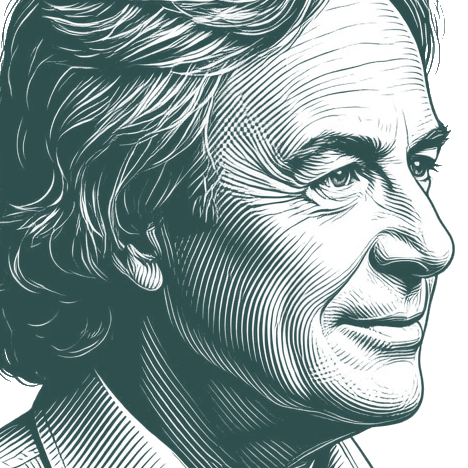
Portrait adapted from
Wikimedia Commons, Copyright Tamiko Thiel 1984 (CC BY-SA)
Also Known As
Pen Names:
Ofey
Native Name:
Richard Phillips Feynman
Alternative Names:
Feynman
•
Dick Feynman
•
Richard P. Feynman
Out of the cradle onto the dry land here it is standing: atoms with consciousness; matter with curiosity. Stands at the sea wonders at wondering: I a universe of atoms an atom in the universe.
I think we should teach them [the people] wonders and that the purpose of knowledge is to appreciate wonders even more.
Try QuoteGPT
Chat naturally about what you need. Each answer links back to real quotes with citations.
Another time somebody gave a talk about poetry. He talked about the structure of the poem and the emotions that come with it; he divided everything up into certain kinds of classes. In the discussion that came afterwards, he said, “Isn’t that the same as in mathematics, Dr. Eisenhart?” Dr. Eisenhart was the dean of the graduate school and a great professor of mathematics. He was also very clever. He said, “I’d like to know what Dick Feynman thinks about it in reference to theoretical physics.” He was always putting me on in this kind of situation. I got up and said, “Yes, it’s very closely related. In theoretical physics, the analog of the word is the mathematical formula, the analog of the structure of the poem is the interrelationship of the theoretical bling-bling with the so-andso”–and I went through the whole thing, making a perfect analogy. The speaker’s eyes were _beaming_ with happiness. Then I said, “It seems to me that no matter _what_ you say about poetry, I could find a way of making up an analog with _any_ subject, just as I did for theoretical physics. I don’t consider such analogs meaningful.