...But it was above all that fragmentation of Albertine into many parts, into many Albertines, that was her sole mode of existence in me. Moments rec… - Marcel Proust
""
...But it was above all that fragmentation of Albertine into many parts, into many Albertines, that was her sole mode of existence in me. Moments recurred in which she had simply been kind, or intelligent, or serious, or even loving sport above all else. And was it not right, after all, that this fragmentation should soothe me? For if it was not in itself something real, if it arose from the continuously changing shape of the hours in which she had appeared to me, a shape which remained that of my memory as the curve of the projections of my magic lantern depended on the curve of the coloured slides, did it not in its own way represent a truly objective truth, this one, namely that none of us is single, that each of us contains many persons who do not all have the same moral value,...
English
Collect this quote
About
Marcel Proust
Valentin Louis Georges Eugène Marcel Proust (10 July 1871 – 18 November 1922) was a French novelist, essayist and critic.
Biography information from
Wikiquote·
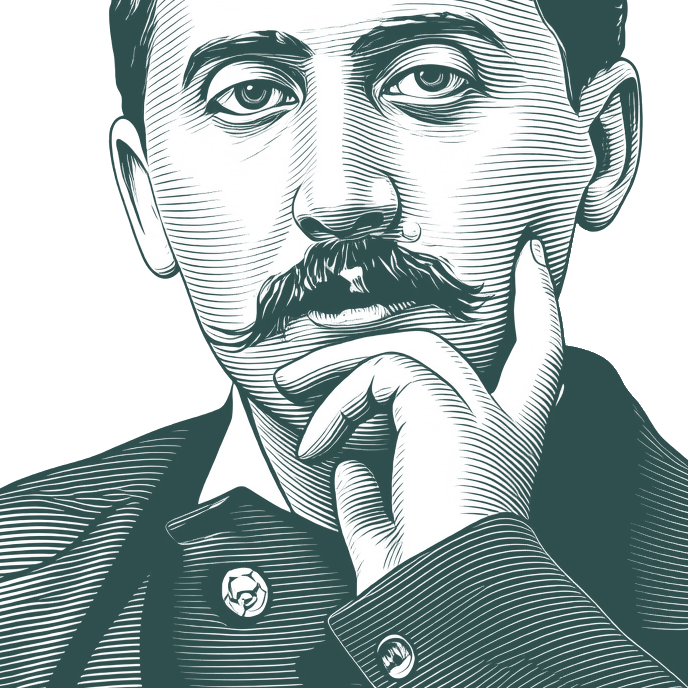
Portrait adapted from
Wikimedia Commons, Otto Wegener (Public domain / CC0)
Also Known As
Alternative Names:
Valentin Louis Georges Eugène Marcel Proust
•
Proust
•
Valentin Louis Georges Eugéne Marcel Proust
•
Valentin-Louis-Georges-Eugéne-Marcel Proust
•
Valentin Louis Georges Eugene Marcel Proust
•
Valentin-Louis-Georges-Eugene-Marcel Proust
•
Bernard d'Algouvres
•
Valentin-Louis-Georges-Eugène-Marcel Proust
She observed the dumb-show by which her neighbour was expressing her passion for music, but she refrained from copying it. This was not to say that, for once that she had consented to spend a few minutes in Mme. de Saint-Euverte's house, the Princesse des Laumes would not have wished (so that the act of politeness to her hostess which she had performed by coming might, so to speak, 'count double') to shew herself as friendly and obliging as possible. But she had a natural horror of what she called 'exaggerating,' and always made a point of letting people see that she 'simply must not' indulge in any display of emotion that was not in keeping with the tone of the circle in which she moved, although such displays never failed to make an impression upon her, by virtue of that spirit of imitation, akin to timidity, which is developed in the most self-confident persons, by contact with an unfamiliar environment, even though it be inferior to their own. She began to ask herself whether these gesticulations might not, perhaps, be a necessary concomitant of the piece of music that was being played, a piece which, it might be, was in a different category from all the music that she had ever heard before; and whether to abstain from them was not a sign of her own inability to understand the music, and of discourtesy towards the lady of the house; with the result that, in order to express by a compromise both of her contradictory inclinations in turn, at one moment she would merely straighten her shoulder-straps or feel in her golden hair for the little balls of coral or of pink enamel, frosted with tiny diamonds, which formed its simple but effective ornament, studying, with a cold interest, her impassioned neighbour, while at another she would beat time for a few bars with her fan, but, so as not to forfeit her independence, she would beat a different time from the pianist's.
The bonds between ourselves and another person exists only in our minds. Memory as it grows fainter loosens them, and notwithstanding the illusion by which we want to be duped and which, out of love, friendship, politeness, deference, duty, we dupe other people, we exist alone. Man is the creature who cannot escape from himself, who knows other people only in himself, and when he asserts the contrary, he is lying.
Enhance Your Quote Experience
Enjoy ad-free browsing, unlimited collections, and advanced search features with Premium.
An impression is for the writer what an experiment is for the scientist, except that for the scientist the work of the intelligence precedes it, and for the writer it comes afterwards.