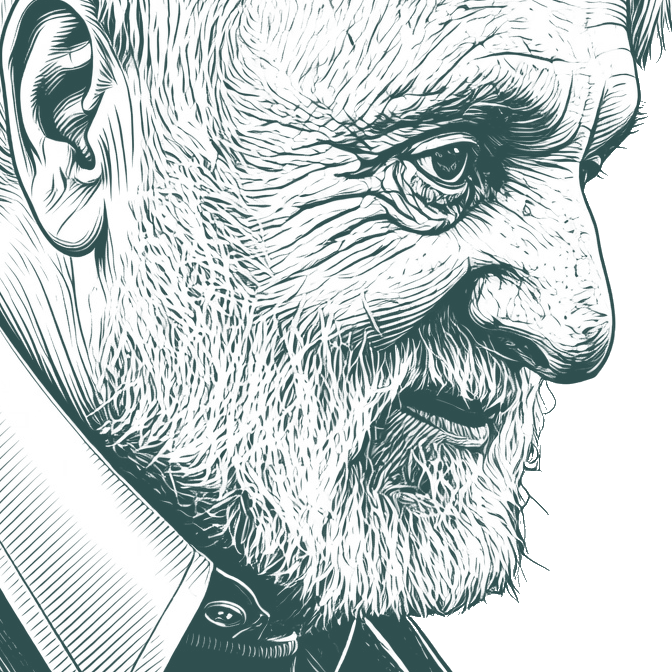
We keep passing unseen through little moments of other people’s lives. - Robert M. Pirsig
""
We keep passing unseen through little moments of other people’s lives.
English
Collect this quote
About
Robert M. Pirsig
Robert Maynard Pirsig (6 September 1928 – 24 April 2017) was an American philosopher and novelist, most famous for his novel Zen and the Art of Motorcycle Maintenance in which he proposed what has become known as his Metaphysics of Quality (MoQ).
Biography information from
Wikiquote·
Portrait adapted from
Wikimedia Commons, Ian Glendinning, en:User:IanGlendinning (CC BY)
Also Known As
Alternative Names:
Robert Maynard Pirsig
•
Robert Pirsig
"At first he found it amusing. He coined a law intended to have the humor of a Parkinson’s law that "The number of rational hypotheses that can explain any given phenomenon is infinite." It pleased him never to run out of hypotheses. Even when his experimental work seemed dead-end in every conceivable way, he knew that if he just sat down and muddled about it long enough, sure enough, another hypothesis would come along. And it always did. It was only months after he had coined the law that he began to have some doubts about the humor or benefits of it. If true, that law is not a minor flaw in scientific reasoning. The law is completely nihilistic. It is a catastrophic logical disproof of the general validity of all scientific method! If the purpose of scientific method is to select from among a multitude of hypotheses, and if the number of hypotheses grows faster than experimental method can handle, then it is clear that all hypotheses can never be tested. If all hypotheses cannot be tested, then the results of any experiment are inconclusive and the entire scientific method falls short of its goal of establishing proven knowledge"
The Immortal Principle was first called water by Thales. Anaximenes called it air. The Pythagoreans called it number and were thus the first to see the Immortal Principle as something nonmaterial. Heraclitus called the Immortal Principle fire and introduced change as part of the Principle. He said the world exists as a conflict and tension of opposites. He said there is a One and there is a Many and the One is the universal law which is immanent in all things. Anaxagoras was the first to identify the One as nous, meaning "mind." Parmenides made it clear for the first time that the Immortal Principle, the One, Truth, God, is separate from appearance and from opinion, and the importance of this separation and its effect upon subsequent history cannot be overstated. It's here that the classic mind, for the first time, took leave of its romantic origins and said, "The Good and the True are not necessarily the same," and goes its separate way. Anaxagoras and Parmenides had a listener named Socrates who carried their ideas into full fruition.
PREMIUM FEATURE
Advanced Search Filters
Filter search results by source, date, and more with our premium search tools.
Any effort that has self-glorification as its final endpoint is bound to end in disaster. Now we’re paying the price. When you try to climb a mountain to prove how big you are, you almost never make it.