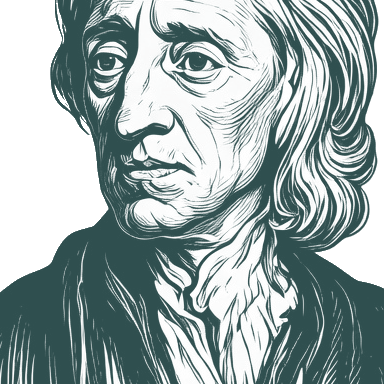
without any express compact of all the commoners. - John Locke
""
without any express compact of all the commoners.
English
Collect this quote
About
John Locke
John Locke (29 August 1632 – 28 October 1704) was an influential English philosopher and social contract theorist. He developed an alternative to the Hobbesian state of nature and asserted a government could be good only if it received the consent of the governed and protected the natural rights of life, liberty, and estate. If such a consent was not achieved, Locke argued in favour of a right of rebellion, which he referred to as an "appeal to heaven".
Biography information from
Wikiquote·
Portrait adapted from
Wikimedia Commons, Godfrey Kneller (Public domain / CC0)
Nor need we fear that this philosophy, while it endeavors to limit our inquiries to common life, should ever undermine the reasonings of common life, and carry its doubts so far as to destroy all action, as well as speculation. Nature will always maintain her rights, and prevail in the end over any abstract reasoning whatsoever. Though we should conclude, for instance, as in the foregoing section, that, in all reasonings from experience, there is a step taken by the mind which is not supported by any argument or process of the understanding; there is no danger that these reasonings, on which almost all knowledge depends, will ever be affected by such a discovery. If the mind be not engaged by argument to make this step, it must be induced by some other principle of equal weight and authority; and that principle will preserve its influence as long as human nature remains the same. What that principle is may well be worth the pains of inquiry.
Mark what 'tis his mind aims at in the question, and not what words he expresses it in: and when you have informed and satisfied him in that, you shall see how his thoughts will enlarge themselves, and how by fit answers he may be led on farther than perhaps you could have imagine. For knowledge is grateful to the understanding, as light to the eyes.
Unlimited Quote Collections
Organize your favorite quotes without limits. Create themed collections for every occasion with Premium.