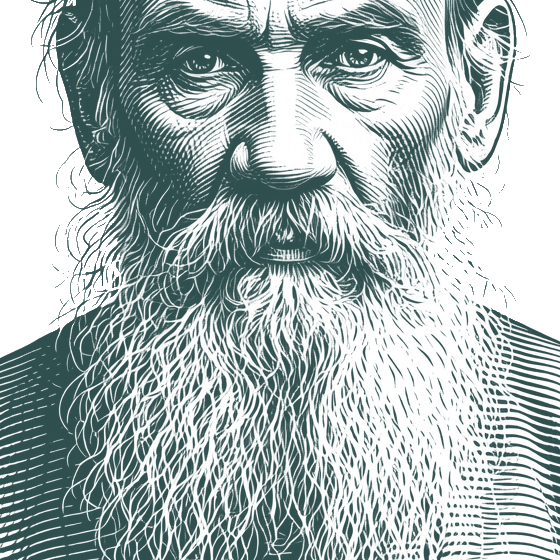
All that day she had had the feeling that she was playing in the theatre with actors better than herself and that her poor playing spoiled the whole … - Leo Tolstoy
""
All that day she had had the feeling that she was playing in the theatre with actors better than herself and that her poor playing spoiled the whole thing.
English
Collect this quote
About
Leo Tolstoy
Lev Nikolayevitch Tolstoy [Ле́в Никола́евич Толсто́й, usually rendered Leo Tolstoy, or sometimes Tolstoi] (9 September 1828 – 20 November 1910) was a Russian writer, philosopher and social activist (social critic), whose novels War and Peace and Anna Karenina are internationally praised classics of world literature. He was a major influence on the development of Christian anarchism and pacifism, contributing to such nonviolent resistance movements as those of Mahatma Gandhi, Martin Luther King, Jr., and James Bevel.
Biography information from
Wikiquote·
Portrait adapted from
Wikimedia Commons, Sergei Prokudin-Gorskii (Public domain / CC0)
Also Known As
Pen Names:
Л. Н. Т.
•
Л. Н.
Birth Name:
Lev Nikolayevich Tolstoy
Native Name:
Лев Никола́евич Толсто́й
Alternative Names:
Count Lev Nikolayevich Tolstoy
•
Tolstoy, Leo, graf, 1828-1910
•
Tolstoĭ, Lev Nikolaevich, graf, 1828-1910
•
Lev Nikolayevich Tolstoĭ
•
Leo Tolstoi
•
Tolstoĭ, Lev Nikolaevich, graf
•
Tolstoy, Leo, graf
In Nekhludoff, as in all people, there were two beings; one spiritual, who sought only such happiness for himself as also benefited others; and the animal being, seeking his own happiness for the sake of which he is willing to sacrifice that of the world.
And the candle by the light of which she had been reading that book filled with anxieties, deceptions, grief and evil, flared up brighter than ever, lit up for her all that had once been darkness, sputtered, grew dim and went out for ever.
Limited Time Offer
Premium members can get their quote collection automatically imported into their Quotewise collections.
The whole trouble lies in that people think that there are conditions excluding the necessity of love in their intercourse with man, but such conditions do not exist. Things may be treated without love; one may chop wood, make bricks, forge iron without love, but one can no more deal with people without love than one can handle bees without care.