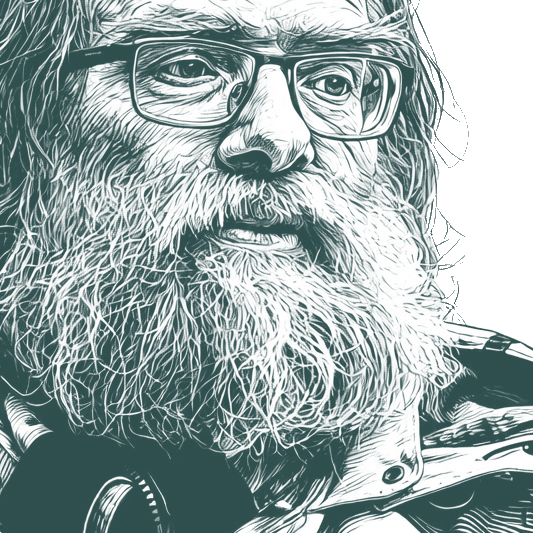
And this makes me think of one more important aspect of the Aryan debate. A debater confident of his position will seek to debate the strongest versi… - Koenraad Elst
""
And this makes me think of one more important aspect of the Aryan debate. A debater confident of his position will seek to debate the strongest version of the opposing position. In that case, the Thapar school would have discussed Talageri’s work threadbare. In reality, they prefer to highlight the Hindutva buffoons who think “history-rewriting” means restating Puranic accounts of history. They seek out the weakest version and then thump their chest at having refuted or ridiculed it. This is seeking cheap success rather than seeking the truth. It is a trick used by the not-so-competent.
English
Collect this quote
About
Koenraad Elst
Koenraad Elst (born 7 August 1959) is a Flemish right wing Hindutva author, known primarily for his support of the Out of India theory and the Hindutva movement. Scholars have accused him of harboring Islamophobia.
For those who look at facts rather than at newspaper headlines, it is obvious that there is no danger whatsoever of the US giving the impression of valuing a Muslim life less than a Hindu life. Rather the reverse, and this consistently for decades. In 1971, the Pakistani Army was butchering Hindus in East Bengal by the hundreds of thousands (many times the total number of victims of Hindutva since then), yet the USA stood by Pakistan and did nothing to rein their Islamic allies in. Throughout the 1990s and till today, Pak-backed terrorists have been butchering Hindus in numerous shootings and bomb attacks and ethnically cleansing them from the Kashmir Valley, yet the USA have not used their leverage with Pakistan to stop this continuous terror wave. Dr. Hathaway's misrepresentation of this highly unbalanced American policy adds insult to injury.
This “bullying” had best been compared to the “bullying” on the other side. Like, for instance, the two attempts by Leftist students to silence me, as a twice scheduled speaker, at the Madison WI South Asia Conference in 1996 and a private event preceding it, hosted by Prof. Andrew Sihler. Or the successful protests against the Dharma Civilization Foundation’s offer to fund a chair at UC Irvine, when so many US chairs are comfortably being funded by the Saudis. ... * I myself have been barred from several Indologist forums by active intervention or passive complicity of the same Professors who otherwise clamour “censorship!” when anything at all happens to a book they favour. ... But when I appealed to them to intervene for annulling my banning from the Religion in South Asia (RISA) list, which had been done in violation of its own charter, they all looked the other way. ... A recent example. In 2014, I read a paper on the Rg-Vedic seer Vasishtha and his relative divinization in a panel on “divinization” at the European Conference for South Asia Studies in Zürich. My paper was enthusiastically received, also by the panel’s organizers when I sent in the final version for publication. First they accepted it, but then, I received an embarrassed e-mail from the organizers stating that they could not include my paper, without any reason given. Upon my enquiring, the half-line reply said that it did not fit their project. In all its insignificance, this still managed to be a blatant lie, and their earlier acceptance confirmed that this could not have been the reason. But some higher up had warned them that I am to be treated as excluded, just like on many other occasions. ... Far more seriously, both in America and in India, scholars suspected of pro-Hindu sympathies are blocked in their access to academe, and their work gets studiously ignored. For India, a tip of the blanket over this hushed-up phenomenon was lifted by Dr. A. Devahuti: Bias in Indian Historiography (1980). It is seriously in need of an update, but I am given to understand that one is forthcoming. For America, a start was made by Rajiv Malhotra with his books Invading the Sacred (2007) and Academic Hinduphobia (2016). ... Anyway, she calls “alleged Hinduphobia” nothing more than “a strawman stand-in for any idea that undercuts Hindutva ideology”. The term was made popular by Rajiv Malhotra, whom I have never known to swear by “Hindutva”, a specific term literally translated as “Hindu-ness” but now effectively meaning “the RSS tradition of Hindu Nationalism”. At any rate, one does not have to follow Hindutva, or even be a Hindu or an Indian, to observe that American India-watchers utter a strong anti-Hindu prejudice in their publications. Not to look too far, I can find an example in myself: I have written a number of publications criticizing both Hindutva as an ideology and the Hindutva organizations, yet I can off-hand enumerate dozens of illustrations of Hindu-baiting by supposed India experts in the West as well as by their Indian counterparts.
In terms of status and career, a non-conformistic stance in favour of the temple cannot be maintained without sacrifice. By contrast, joining the anti-temple party has always been a smart career move. Far from requiring bravery, posturing as a “committed secularist” up in arms against “obscurantist and communalist history manipulation” will only earn you praise... India’s secularist academics and journalists form a society of mutual praise, and the cheapest way of getting applause in elite India is to attack the Hindu movement.