The interpretation of quantum mechanics has been dealt with by many authors, and I do not want to discuss it here. I want to deal with more fundament… - Paul Adrien Maurice Dirac
""
The interpretation of quantum mechanics has been dealt with by many authors, and I do not want to discuss it here. I want to deal with more fundamental things.
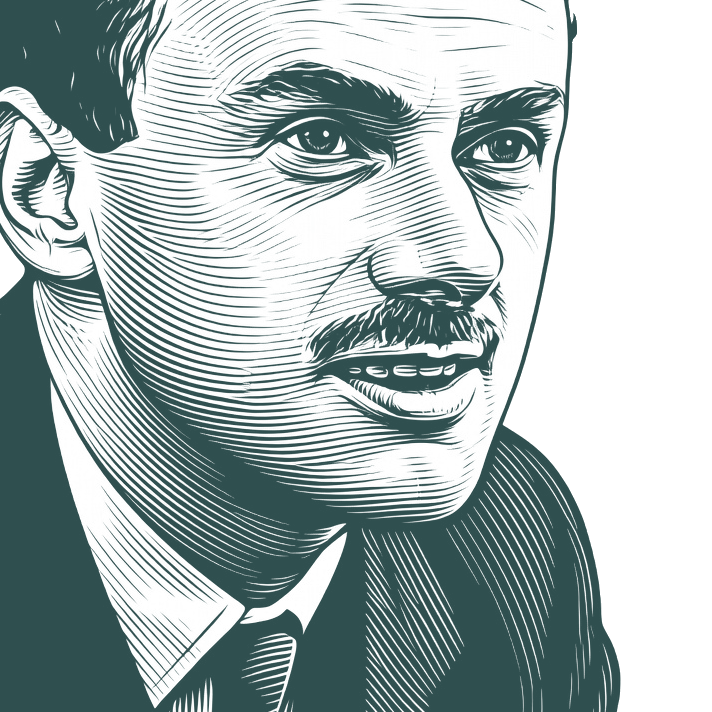
Paul Adrien Maurice Dirac (8 August 1902 – 20 October 1984) was an English mathematical and theoretical physicist who is considered to be one of the founders of quantum mechanics. Dirac laid the foundations for both quantum electrodynamics and quantum field theory. He was the Lucasian Professor of Mathematics at the University of Cambridge, a professor of physics at Florida State University, and a 1933 Nobel Prize in Physics recipient.
Biography information from
Wikiquote·
Portrait adapted from
Wikimedia Commons, Nobel Foundation (Public domain / CC0)
Also Known As
Alternative Names:
Paul A M Dirac
•
P A M Dirac
•
P. A. M. Dirac
•
Paul Dirac
Living is worthwhile if one can contribute in some small way to this endless chain of progress.
The nature of the relationships which the superposition principle requires to exist between the states of any system is of a kind that cannot be explained in terms of familiar physical concepts. One cannot in the classical sense picture a system being partly in each of two states and see the equivalence of this to the system being completely in some other state. There is an entirely new idea involved, to which one must get accustomed and in terms of which one must proceed to build up an exact mathematical theory, without having any detailed classical picture.
PREMIUM FEATURE
Advanced Search Filters
Filter search results by source, date, and more with our premium search tools.
At the beginning of time the laws of Nature were probably very different from what they are now. Thus we should consider the laws of Nature as continually changing with the epoch, instead of as holding uniformly throughout space-time. This idea was first put forward by Milne, who worked it out on... assumptions... not very satisfying... we should expect them also to depend on position in space, in order to preserve the beautiful idea of the theory of relativity [that] there is fundamental similarity between space and time.