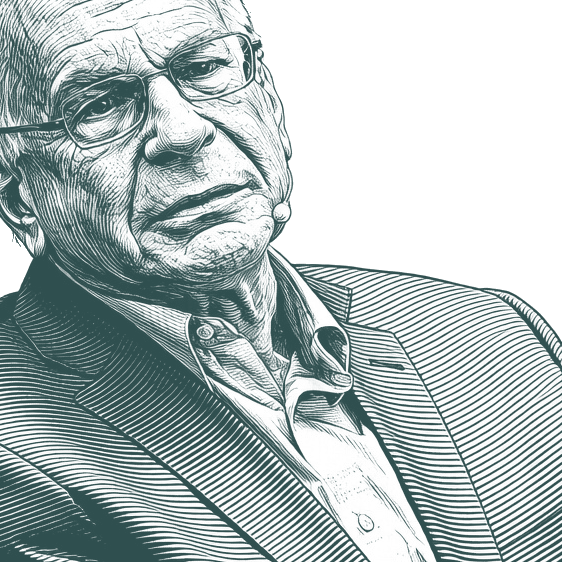
An unbiased appreciation of uncertainty is a cornerstone of rationality — but it is not what people and organizations want. Extreme uncertainty is pa… - Daniel Kahneman
""
An unbiased appreciation of uncertainty is a cornerstone of rationality — but it is not what people and organizations want. Extreme uncertainty is paralyzing under dangerous circumstances, and the admission that one is merely guessing is especially unacceptable when the stakes are high. Acting on pretended knowledge is often the preferred solution.
Daniel Kahneman (March 5, 1934 – March 27, 2024) was an Israeli-American psychologist. He shared the 2002 Nobel Memorial Prize in Economic Sciences with Vernon L. Smith. Kahneman is notable for his work on the psychology of judgment and decision-making, behavioral economics and hedonic psychology. Latterly, he was professor emeritus of psychology and public affairs at Princeton University's Woodrow Wilson School.
the proper way to elicit information from a group is not by starting with a public discussion but by confidentially collecting each person’s judgment. This procedure makes better use of the knowledge available to members of the group than the common practice of open discussion.
There's a lot of randomness in the decisions that people make.
PREMIUM FEATURE
Advanced Search Filters
Filter search results by source, date, and more with our premium search tools.