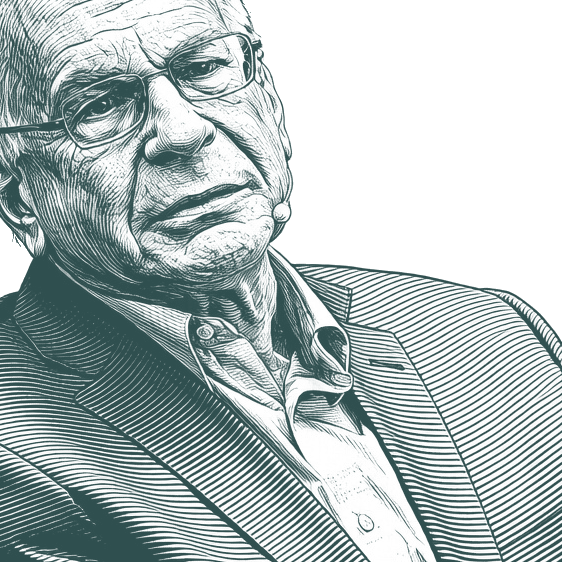
Israeli-American psychologist and economist (1934–2024)
Daniel Kahneman (March 5, 1934 – March 27, 2024) was an Israeli-American psychologist. He shared the 2002 Nobel Memorial Prize in Economic Sciences with Vernon L. Smith. Kahneman is notable for his work on the psychology of judgment and decision-making, behavioral economics and hedonic psychology. Latterly, he was professor emeritus of psychology and public affairs at Princeton University's Woodrow Wilson School.
Bio from: Wikiquote (CC BY-SA 4.0) · Portrait adapted from: Wikimedia Commons, nrkbeta (CC BY-SA)
From Wikidata (CC0)
Works in ChatGPT, Claude, or Any AI
Add semantic quote search to your AI assistant via MCP. One command setup.
Subjective confidence in a judgement is not a reasoned evaluation of the probability that this judgement is correct. Confidence is a feeling, which reflects the coherence of the information and the cognitive ease of processing it. It is wise to take admissions of uncertainty seriously, but declarations of high confidence mainly tell you that an individual has constructed a coherent story in his mind, not necessarily that the story is true.
My advice to students when I taught negotiations was that if you think the other side has made an outrageous proposal, you should not come back with an equally outrageous counteroffer, creating a gap that will be difficult to bridge in further negotiations. Instead you should make a scene, storm out or threaten to do so, and make it clear — to yourself as well as to the other side — that you will not continue the negotiation with that number on the table.
Limited Time Offer
Premium members can get their quote collection automatically imported into their Quotewise collections.
However, optimism is highly valued, socially and in the market; people and firms reward the providers of dangerously misleading information more than they reward truth tellers. One of the lessons of the financial crisis that led to the Great Recession is that there are periods in which competition, among experts and among organizations, creates powerful forces that favor a collective blindness to risk and uncertainty.
A general “law of least effort” applies to cognitive as well as physical
exertion. The law asserts that if there are several ways of achieving the
same goal, people will eventually gravitate to the least demanding course
of action. In the economy of action, effort is a cost, and the acquisition of
skill is driven by the balance of benefits and costs. Laziness is built deep into our nature.
Try QuoteGPT
Chat naturally about what you need. Each answer links back to real quotes with citations.