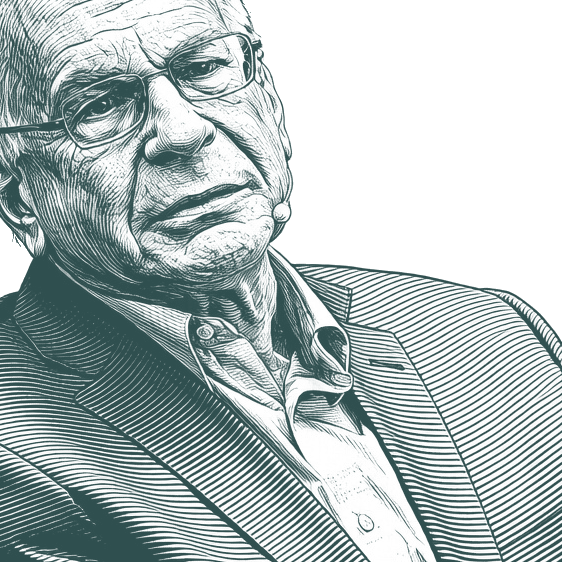
The worse the consequence, the greater the hindsight bias. - Daniel Kahneman
""
The worse the consequence, the greater the hindsight bias.
English
Collect this quote
About
Daniel Kahneman
Daniel Kahneman (March 5, 1934 – March 27, 2024) was an Israeli-American psychologist. He shared the 2002 Nobel Memorial Prize in Economic Sciences with Vernon L. Smith. Kahneman is notable for his work on the psychology of judgment and decision-making, behavioral economics and hedonic psychology. Latterly, he was professor emeritus of psychology and public affairs at Princeton University's Woodrow Wilson School.
A general limitation of the human mind is its imperfect ability to reconstruct past states of knowledge, or beliefs that have changed. Once you adopt a new view of the world (or of any part of it), you immediately lose much of your ability to recall what you used to believe before your mind changed.
Nothing in life is as important as you think it is when you are thinking about it.
Go Premium
Support Quotewise while enjoying an ad-free experience and premium features.
The often-used phrase “pay attention” is apt: you dispose of a limited budget of attention that you can allocate to activities, and if you try to you try to go beyond your budget, you will fail.