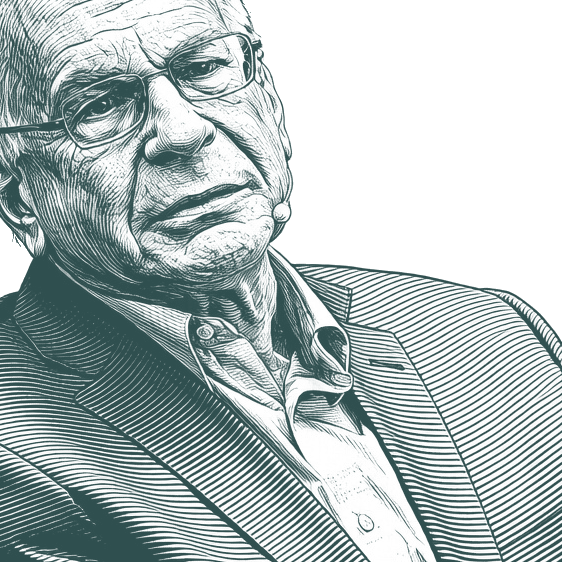
Israeli-American psychologist and economist (1934–2024)
Daniel Kahneman (March 5, 1934 – March 27, 2024) was an Israeli-American psychologist. He shared the 2002 Nobel Memorial Prize in Economic Sciences with Vernon L. Smith. Kahneman is notable for his work on the psychology of judgment and decision-making, behavioral economics and hedonic psychology. Latterly, he was professor emeritus of psychology and public affairs at Princeton University's Woodrow Wilson School.
Bio from: Wikiquote (CC BY-SA 4.0) · Portrait adapted from: Wikimedia Commons, nrkbeta (CC BY-SA)
From Wikidata (CC0)
We often interact with professionals who exercise their judgment with evident confidence, sometimes priding themselves on the power of their intuition. In a world rife with illusions of validity and skill, can we trust them? How do we distinguish the justified confidence of experts from the sincere overconfidence of professionals who do not know they are out of their depth? We can believe an expert who admits uncertainty but cannot take expressions of high confidence at face value. As I first learned on the obstacle field, people come up with coherent stories and confident predictions even when they know little or nothing. Overconfidence arises because people are often blind to their own blindness.
Works in ChatGPT, Claude, or Any AI
Add semantic quote search to your AI assistant via MCP. One command setup.
However, optimism is highly valued, socially and in the market; people and firms reward the providers of dangerously misleading information more than they reward truth tellers. One of the lessons of the financial crisis that led to the Great Recession is that there are periods in which competition, among experts and among organizations, creates powerful forces that favor a collective blindness to risk and uncertainty.
Enhance Your Quote Experience
Enjoy ad-free browsing, unlimited collections, and advanced search features with Premium.
Works in ChatGPT, Claude, or Any AI
Add semantic quote search to your AI assistant via MCP. One command setup.
When forecasting the outcomes of risky projects, executives too easily fall victim to the planning fallacy. In its grip, they make decisions based on delusional optimism rather than on a rational weighting of gains, losses, and probabilities. They overestimate benefits and underestimate costs. They spin scenarios of success while overlooking the potential for mistakes and miscalculations. As a result, they pursue initiatives that are unlikely to come in on budget or on time or to deliver the expected returns — or even to be completed. In this view, people often (but not always) take on risky projects because they are overly optimistic about the odds they face. I will return to this idea several times in this book — it probably contributes to an explanation of why people litigate, why they start wars, and why they open small businesses.