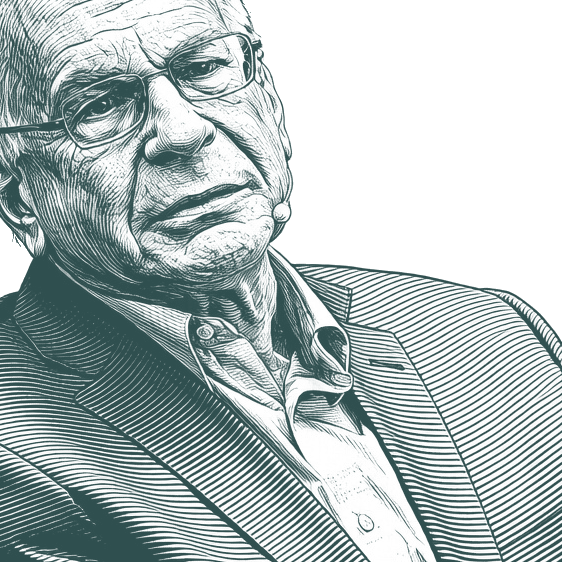
A reliable way to make people believe in falsehoods is frequent repetition, because familiarity is not easily distinguished from truth. Authoritarian… - Daniel Kahneman
""
A reliable way to make people believe in falsehoods is frequent repetition, because familiarity is not easily distinguished from truth. Authoritarian institutions and marketers have always known this fact.
Daniel Kahneman (March 5, 1934 – March 27, 2024) was an Israeli-American psychologist. He shared the 2002 Nobel Memorial Prize in Economic Sciences with Vernon L. Smith. Kahneman is notable for his work on the psychology of judgment and decision-making, behavioral economics and hedonic psychology. Latterly, he was professor emeritus of psychology and public affairs at Princeton University's Woodrow Wilson School.
Optimism is normal, but some fortunate people are more optimistic than the rest of us. If you are genetically endowed with an optimistic bias, you hardly need to be told that you are a lucky person -- you already feel fortunate. Optimistic people play a disproportionate role in shaping our lives. Their decisions make a difference; they are inventors, entrepreneurs, political and military leaders -- not average people. They got to where they are by seeking challenges and taking risks. They are talented and they have been lucky, almost certainly luckier than they acknowledge.
In a state of flow, however, maintaining focused attention on these absorbing activities requires no exertion of self-control, thereby freeing resources to be directed to the task at hand.
Works in ChatGPT, Claude, or Any AI
Add semantic quote search to your AI assistant via MCP. One command setup.
People who are poor think like traders, but the dynamics are quite different. Unlike traders, the poor are not indifferent to the differences between gaining and giving up. Their problem is that all their choices are between losses. Money that is spent on one good is the loss of another good that could have been purchased instead. For the poor, costs are losses.