The right use of the exercise of the will is a condition of salvation, necessary without a doubt, but remote, inferior, very subordinated, purely neg… - Simone Weil
""
The right use of the exercise of the will is a condition of salvation, necessary without a doubt, but remote, inferior, very subordinated, purely negative. Muscular effort pulls up weeds, but only the sun and water can make wheat grow. The will cannot produce any good in the soul. The efforts of the will are only in place for accomplishing specific obligations. Wherever there is no specific obligation, we must follow our natural inclination or our vocation, which to say the commandment of God. The acts proceeding from inclination are evidently not efforts of the will. And in acts of obedience to God, we remain passive. Whatever pains might accompany it, whatever deployment of activity might be apparent, they produce nothing analogous in the soul to muscular effort. There is only expectant waiting, attentiveness, silence and immobility through suffering and joy. The crucifixion of Christ is the model of all acts of obedience.
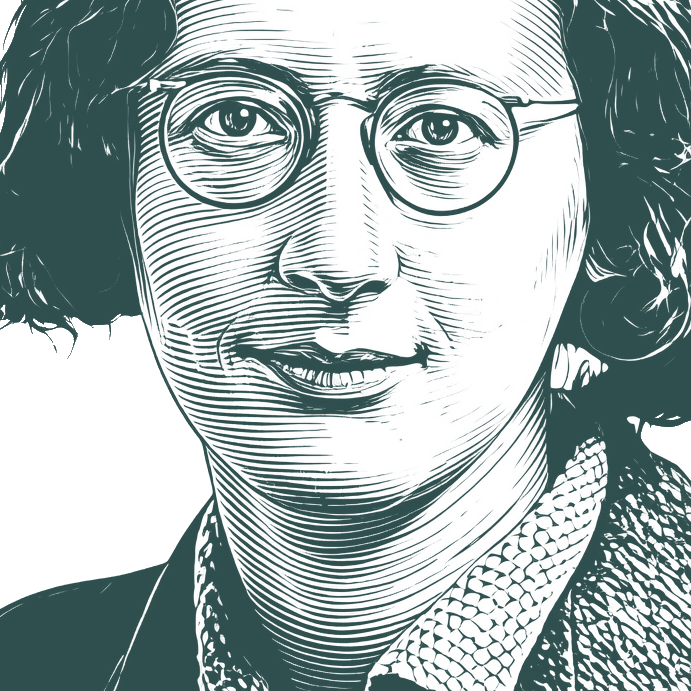
Simone Adolphine Weil (3 February 1909 – 24 August 1943) was a French social and religious philosopher, and Christian mystic. Politically active, during the Spanish Civil War she joined the Anarchist military unit known as the Durruti Column, and took part in the French Resistance during World War II. She was the sister of mathematician André Weil, with whom she shared an interest in ancient Greek and Indian thought.
Every time that a man has, with a pure heart, called upon Osiris, Dionysus, Buddha, the Tao, etc., the Son of God has answered him by sending the Holy Spirit. And the Holy Spirit has acted upon his soul, not by inciting him to abandon his religious tradition, but by bestowing upon him light — and in the best of cases the fullness of light — in the heart of that same religious tradition. … It is, therefore, useless to send out missions to prevail upon the peoples of Asia, Africa or Oceania to enter the Church.
God rewards the soul that focuses on Him with attention and love, and God rewards that soul by exercising a rigorous compulsion on it, mathematically proportional to this attention and love. We must abandon ourselves to this pressure, and run to the precise point where it leads, and not a single step further, not even in the direction of what is good. At the same time, we must continue to focus on God, with ever more love and attention, and in this way obtain an even greater compulsion — to become an object of a compulsion that possesses for itself a perpetually growing portion of the soul. Once God’s compulsion possesses the whole soul, one has reached the state of perfection. But no matter what degree we reach, we must not accomplish anything beyond what we are irresistibly pressured (compelled) to do, not even in the way of good.
When one is born into a religion that is not too unsuitable for pronouncing the name of the Lord, when one loves that native religion, well-oriented and pure, it is difficult to conceive of a legitimate motive to abandon it before direct contact with God offers the soul to the divine will itself. Beyond this threshold, the change is only legitimate as an act of obedience. In fact history shows how this rarely happens. More often — perhaps always — the soul that reaches the highest spiritual regions is confirmed in the love of the tradition that served as its ladder. If the imperfection of the native religion is too great, or if it appears in a native environment under a form that is too corrupt, or if circumstances prevent that religion from being born or even kills it, the adoption of a strange religion is legitimate. Legitimate and necessary for certain people; not, without a doubt, for all. It is the same for those who have been raised without any religious practice. In all other cases, to change religions is an extremely grave (serious) decision and it is even more serious to push someone else to do so. It is still an infinitely more serious exercise, in this sense, to officially apply such pressure upon conquered lands.