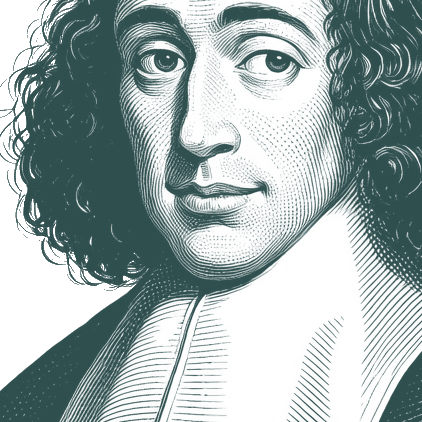
As the French philosopher Louis Althusser wrote in his 1976 Essays in Self-Criticism, much late 20th century Spinozism has proceeded by ‘attributing … - Benedictus de Spinoza
""
As the French philosopher Louis Althusser wrote in his 1976 Essays in Self-Criticism, much late 20th century Spinozism has proceeded by ‘attributing to the author of the Tractatus Theologico-Politicus and the Ethics a number of theses which he would surely never have acknowledged, though they did not actually contradict him. But to be a heretical Spinozist is almost orthodox Spinozism, if Spinozism can be said to be one of the greatest lessons in heresy that the world has seen!’. Though Spinozists have existed ever since the radical circles that rippled through Europe in the wake of Spinoza's death, I think it is fair to say that only in the past 50 years or so has there been a Spinozism to match in hermeneutic rigour and creative interventions the history of Kantianism or Hegelianism, that only now has the hereticism that Althusser referred to been complemented by the labour of the concept. Arguably, it is only now then that the scope of his thought and its relevance to our social and political existence can be truly appreciated, at a historical juncture when the communicative power of the multitude and of what Marx called the general intellect is so intensified that the physics, ethics, ontology and politics of Spinoza (what are ultimately indissociable facets of his philosophizing) can be thought simultaneously. Today more than ever, one might argue, is Spinoza, as Pierre Macherey puts it, ‘an irreplaceable reactor and developer’.
English
Collect this quote
About
Benedictus de Spinoza
Benedictus de Spinoza (24 November 1632 – 21 February 1677) was a social and metaphysical philosopher known for the elaborate development of his monist philosophy, which has become known as Spinozism. Controversy regarding his ideas led to his excommunication from the Jewish community of his native Amsterdam. He was named Baruch ("blessed" in Hebrew) Spinoza by his synagogue elders and known as Bento de Spinoza or Bento d'Espiñoza, but afterwards used the name Benedictus ("blessed" in Latin) de Spinoza.
Native Name:
בָּרוּךְ שְׂפִּינוֹזָה
•
Benedito de Espinosa
Alternative Names:
Benedict de Spinoza
•
Baruch de Espinosa
•
Barukh Shpinozah
•
Benoît de Spinoza
•
Sbīnūzā
•
Ispīnūzā
•
Barukh Spinoza
•
Bento de Espinosa
•
Baruch d' Espinoza
•
Shpinozah
•
Baruch de Spinoza
•
Spinoza
•
Benoit de Spinoza
•
Benedictus De Spinoza
•
Benedictus Spinoza
•
Baruch Spinoza
•
Baruch Benedictus de Spinoza
[The] right of the individual is co-extensive with its determinate power. ... Nature's bounds are not set by the laws of human reason which aim only at man's true interest and his preservation ... man is but a particle.
My ancestors Heraclitus, Empedocles, Spinoza, Goethe. [Original in German: meine Vorfahren Heraclit Empedocles Spinoza Goethe.]
Enhance Your Quote Experience
Enjoy ad-free browsing, unlimited collections, and advanced search features with Premium.
Mais il est des gens qui croient que la fiction est limitée par la fiction, et non par l'intelligence ; c'est-à-dire qu'après avoir feint une chose, et avoir affirmé, par un acte libre de la volonté, l'existence de cette chose, déterminée d'une certaine manière dans la nature, il ne nous est plus possible de la concevoir autrement. Par exemple, après avoir feint (pour parler leur langage) que la nature du corps est telle ou telle, il ne m'est plus permis de feindre une mouche infinie ; après avoir feint l'essence de l'âme, il ne m'est plus permis d'en faire un carré, etc. Cela a besoin d'être examiné. D'abord, ou bien ils nient, ou bien ils accordent que nous pouvons comprendre quelque chose. L'accordent-ils ; ce qu'ils disent de la fiction, ils devront nécessairement le dire aussi de l'intelligence. Le nient-ils ; voyons donc, nous qui savons que nous savons quelque chose, ce qu'ils disent. Or, voici ce qu'ils disent : l'âme est capable de sentir et de percevoir de plusieurs manières, non pas elle-même, non pas les choses qui existent, mais seulement les choses qui ne sont ni en elle-même ni ailleurs : en un mot, l'âme, par sa seule vertu, peut créer des sensations, des idées, sans rapport avec les choses, à ce point qu'ils la considèrent presque comme un dieu. Ils disent donc que notre âme possède une telle liberté qu'elle a le pouvoir et de nous contraindre et de se contraindre elle-même et de contraindre jusqu'à sa liberté elle-même. En effet, lorsque l'âme a feint quelque chose et qu'elle a donné son assentiment à cette fiction, il ne lui est plus possible de se représenter ou de feindre la même chose d'une manière différente ; et en outre, elle se trouve condamnée à se représenter toutes choses de façon qu'elles soient en accord avec la fiction primitive. C'est ainsi que nos adversaires se trouvent obligés par leur propre fiction d'accepter toutes les absurdités qu'on vient d'énumérer, et que nous ne prendrons pas la peine de combattre par des démonstrations .