If the world is eternally moving and developing matter (as the Marxists think), reflected by the developing human consciousness, what is there “stati… - Vladimir Lenin
""
If the world is eternally moving and developing matter (as the Marxists think), reflected by the developing human consciousness, what is there “static” here? The point at issue is not the immutable essence of things, or an immutable consciousness, but the correspondence between the consciousness which reflects nature and the nature which is reflected by consciousness.
English
Collect this quote
About
Vladimir Lenin
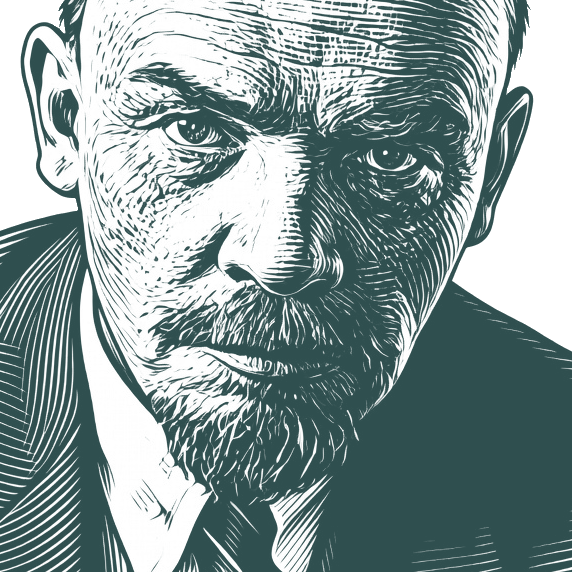
Vladimir Ilyich Lenin (Russian: Владимир Ильич Ленин), born Vladimir Ilyich Ulyanov (Russian: Влади́мир Ильи́ч Ульянов) (22 April 1870 (10 April (O.S.)) – 21 January 1924) was a Russian revolutionary, the leader of the Bolshevik communist party, the first Premier of the Soviet Union and the main theorist of Leninism. He married the revolutionary Nadezhda Krupskaya in 1898.
Portrait adapted from
Wikimedia Commons, Pavel Zhukov (Public domain / CC0)
Also Known As
Pen Names:
Ленин
•
Ильин
•
Н. Ленин
•
Старик
•
К. Тулин
•
Lenin
Native Name:
Владимир Ильич Ленин
Alternative Names:
Vladimir Ilyich Lenin
•
Vladimir Ilyich Ulyanov
•
Vladimir Il'ich Lenin
•
Vladimir Il'ich Ul'yanov
•
V. I. Ul'yanov
•
V. I. Lenin
•
Vladimir Ulyanov
•
Vladimir Ul'yanov
•
V. I. Ulyanov
•
Vl llyin
•
Владимир Ильич Ульянов
Complete equality of rights for all nations; the right of nations to self-determination; the unity of the workers of all nations — such is the national programme that Marxism, the experience of the whole world, and the experience of Russia, teach the workers.
It is still necessary to suppress the bourgeoisie and crush its resistance. This was particularly necessary for the Commune; and one of the reasons for its defeat was that it did not do this with sufficient determination. But the organ of suppression is now the majority of the population, and not the minority, as was always the case under slavery, serfdom and wage-slavery. And since the majority of the people itself suppresses its oppressors, a "special force" for suppression is no longer necessary. in this sense the state begins to wither away. Instead of the special institutions of a privileged minority.. the majority can directly fulfill all these functions, and the more the functions of state power devolve upon the people generally, the less need is there for the existence of this power.
The Poor Peasants' Committees are necessary to fight the kulaks, the rich, the exploiters, who shackle the working peasants. But between the kulaks, who are a small minority, and the poor or semi-proletarians there is the section of the middle peasants. The Soviet government has never declared or conducted any struggle against them. Any steps or measures to the contrary must be condemned most vigorously and stopped. The socialist government must pursue a policy of agreement with the middle peasants.