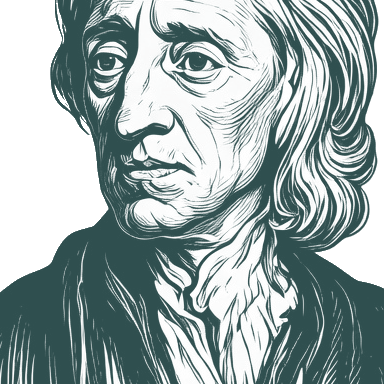
I found the two extremes that men run into on this point, either on the one hand shook the foundations of all religion, or, on the other, made christ… - John Locke
""
I found the two extremes that men run into on this point, either on the one hand shook the foundations of all religion, or, on the other, made christianity almost nothing: for while some men would have all Adam’s posterity doomed to eternal, infinite punishment, for the transgression of Adam, whom millions had never heard of, and no one had authorised to transact for him, or be his representative; this seemed to others so little consistent with the justice or goodness of the great and infinite God, that they thought there was no redemption necessary, and consequently, that there was none;
English
Collect this quote
About
John Locke
John Locke (29 August 1632 – 28 October 1704) was an influential English philosopher and social contract theorist. He developed an alternative to the Hobbesian state of nature and asserted a government could be good only if it received the consent of the governed and protected the natural rights of life, liberty, and estate. If such a consent was not achieved, Locke argued in favour of a right of rebellion, which he referred to as an "appeal to heaven".
Biography information from
Wikiquote·
Portrait adapted from
Wikimedia Commons, Godfrey Kneller (Public domain / CC0)
Chapter VII Of Simple Ideas of both Sensation and Reflection 1. Ideas of pleasure and pain. There be other simple ideas which convey themselves into the mind by all the ways of sensation and reflection, viz. pleasure or delight, and its opposite, pain, or uneasiness; power; existence; unity.
To speak less learnedly, and more intelligibly,
PREMIUM FEATURE
Advanced Search Filters
Filter search results by source, date, and more with our premium search tools.
equality which all men are in, in respect of jurisdiction or dominion one over another; which was the equality I there spoke of, as proper to the business in hand, being that equal right that every man hath to his natural freedom, without being subjected to the will or authority of any other man.